
Reviewed · RANTHAMBORE TIGER SAFARI TOURS FROM DELHI
7-Day Golden Triangle & Ranthambore Tiger Safari from Delhi
The best part of this seven-day route is the mix: grand Mughal monuments, Jaipur’s pink sandstone palaces, and two chances to search for tigers in Ranthambore National Park. In one week, you cover Delhi, Agra, Jaipur, and a major wildlife reserve without having to arrange each hotel, driver, transfer, and guide yourself.
I like the private-car format, which gives your own group more control than a large coach tour. I also like the balance between famous sights and a less predictable safari. The Taj Mahal is almost certain to be a highlight, while Ranthambore adds the thrill of not knowing exactly what you will see.
The main drawback is the pace. This is a sightseeing-heavy trip with long road journeys, early starts, and several hotel changes. The price is attractive at $550 per person, but monument tickets, meals, drinks, tips, and some safari details are extra, so you should budget beyond the headline figure.
Key points to know before booking
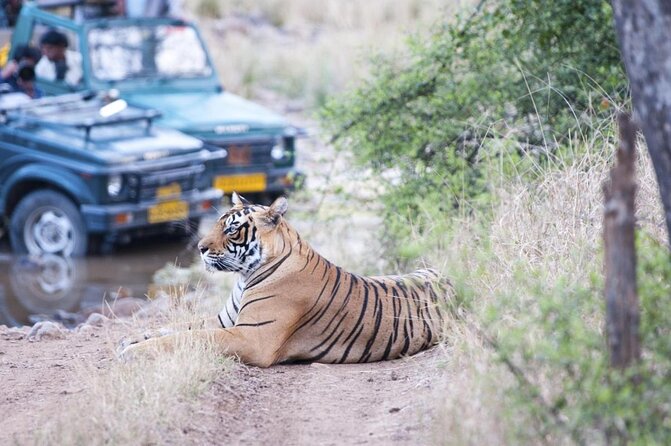
- Two Ranthambore safari opportunities: The schedule includes a five-hour park visit and a three-hour sunrise visit, with the included number of canter safaris depending on the hotel category you choose.
- A private tour for your own group: Transportation, tolls, parking, fuel, and driver allowances are included, which keeps the route simple.
- The Taj Mahal at sunrise: The early visit gives you the classic soft light and helps place India’s most famous monument at the center of the Agra stay.
- Guides in Jaipur and Agra: Local guides are included in these two cities, but not listed for Delhi or Ranthambore.
- Six nights of accommodation and breakfast: This removes much of the daily planning, though hotel names and room standards depend on the selected option.
- A demanding final day in Delhi: You may see seven major stops before your airport transfer, so confirm the timing of your departure flight carefully.
What the $550 price really covers
At $550 per person, this trip can be good value for a first visit to North India. Six nights of accommodation, daily breakfasts, a private vehicle with driver, local taxes, and park fees are included. You also receive local guiding in Jaipur and Agra, where interpretation can make a real difference at the City Palace, Amer Fort, the Taj Mahal, and Agra Fort.
The cost does not cover food and drinks, travel insurance, tips, laundry, phone calls, personal expenses, or most monument admission tickets. The itinerary specifically lists admission charges as extra at several major sights, including the City Palace, Jantar Mantar, Hawa Mahal, Amer Fort, Nahargarh Fort, the Taj Mahal, Agra Fort, Itmad-ud-Daula, Jama Masjid, the Red Fort, Humayun’s Tomb, and Qutub Minar.
That matters because the monuments are not side stops. They are the heart of the trip. Your final price will be higher once you add entrance fees, meals, and gratuities.
The safari arrangement also needs careful reading. The included park fees cover one canter safari with the three-star option and two canter safaris with the four-star option. If seeing a tiger is a major reason for booking, the four-star choice may offer better value simply because it provides the second included outing. A tiger sighting can never be promised, but two park drives give you more time and a better chance than one.
More tiger safaris and wildlife trips from New Delhi:
- Private 4-Day Golden Triangle Tour with Ranthambore Tiger Safari
★ 5.0 · 248 reviews - Private 5-Day Ranthambhore Tiger Tour from Delhi including the Taj Mahal, Agra and Jaipur
★ 5.0 · 197 reviews - 4 Day Golden Triangle with Ranthambore Tiger Safari Tour from Delhi
★ 5.0 · 110 reviews
Day 1: A simple Delhi arrival
Your tour begins at Indira Gandhi International Airport, where a representative meets you and transfers you to your Delhi hotel. This is a practical first day rather than a sightseeing day, which is sensible after an international flight.
The arrival arrangement is especially useful if this is your first time in India. You do not need to negotiate a taxi, find the hotel yourself, or work out the first transfer after landing. Keep your passport details accurate when booking, since the operator requires the passport name, number, expiry date, and country for every participant.
The accommodation is on double, twin, or triple sharing. A child rate is available only when the child shares with two paying adults, so families should check the room setup before paying.
Day 2: Jaipur’s City Palace, Jantar Mantar, and Hawa Mahal
After breakfast, you drive to Jaipur, the capital of Rajasthan. The schedule allows about five hours for the drive and the first Jaipur touring, so this is not a leisurely city arrival. Once you reach the Pink City, you visit the City Palace, Jantar Mantar, and Hawa Mahal.
The City Palace is a good first stop because it introduces Jaipur’s royal past through courtyards, buildings, and decorative details. It was founded when Maharaja Sawai Jai Singh II moved his court from Amber to Jaipur in 1727. Give yourself time to look beyond the grand façades, since the palace complex is made up of several sections rather than one single room or hall.
Jantar Mantar is one of Jaipur’s most unusual sights. Its large stone and masonry instruments were built for astronomical observation and completed in 1734. The scale is impressive, but the site makes more sense with a guide who can explain what the instruments measured and why they were built so large.
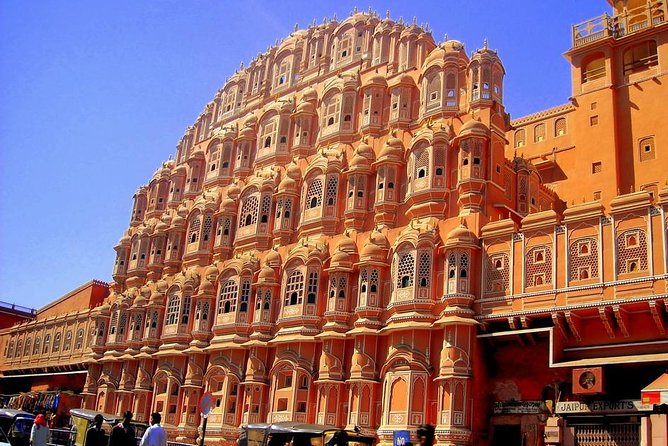
Hawa Mahal, the Palace of Winds, is Jaipur’s most recognizable façade. Built from pink and red sandstone beside the City Palace, it is known for its many small windows and screened openings. The exterior photo is quick, while the meaning of the building becomes clearer when you learn about the women of the royal household and the way they viewed street life from behind the screens.
Admission tickets for these three stops are not included. You should also expect crowds and traffic around central Jaipur. The included local guide is valuable here, since these sights are much more than photo stops.
Day 3: Amer Fort, Nahargarh Fort, and Jal Mahal
The next day moves outside central Jaipur. Amer Fort, also called Amber Palace, sits on a hill about 11 kilometers from Jaipur and is scheduled for roughly three hours. Its setting is a major part of the appeal, with the fort rising above the surrounding area and offering a strong sense of how the old capital was defended and organized.
You should wear comfortable walking shoes. Fort visits involve uneven surfaces, steps, and time outdoors, and the itinerary gives you enough time to explore rather than just stop for a photograph. Admission is extra.
Nahargarh Fort takes another two hours and sits along the Aravalli Hills above Jaipur. Together with Amer Fort and Jaigarh Fort, it formed part of the city’s defensive system. The fort is especially useful for getting a wider view of Jaipur after spending the previous day among palaces and courtyards.
The day also includes a stop at Jal Mahal, the palace set in Man Sagar Lake. The palace and lake were renovated and enlarged in the 18th century. The schedule does not specify a long interior visit, so treat this as a scenic stop rather than a full palace tour.
This is one of the stronger days for variety: a royal fort, a hilltop fort, and a lake palace. The drawback is that Jaipur’s sights are spread out, so traffic can affect the rhythm of the day.
More Golden Triangle routes from New Delhi:
- 3-Days Private Golden Triangle Tour: Delhi, Agra & Jaipur by Car
★ 5.0 · 1,107 reviews - 3-Days Private Golden Triangle Tour: Delhi, Agra & Jaipur by Car
★ 5.0 · 1,098 reviews - 3-Day Delhi, Agra and Jaipur Private Tour – India Golden Triangle
★ 5.0 · 812 reviews - Four-Day Private Luxury Golden Triangle Tour to Agra and Jaipur From New Delhi
★ 5.0 · 807 reviews
Days 4 and 5: The tiger search in Ranthambore
Ranthambore is the trip’s wild card. The national park was once a royal hunting ground and is now known for tigers, leopards, marsh crocodiles, and other wildlife. Unlike a monument visit, a safari does not follow a script. You may see a tiger, or you may spend the drive watching for movement, tracks, birds, or animals near the water.
Day 4 includes about five hours in Ranthambore National Park. Day 5 adds a sunrise visit of about three hours before the route continues toward Fatehpur Sikri. That early start is worth taking seriously. Bring warm layers if needed, carry water, and expect an open vehicle and extended periods of waiting and watching.
The included vehicle is a canter safari, and the number included depends on your accommodation selection. The three-star option includes one canter safari, while the four-star option includes two. The schedule describes two park opportunities, so confirm exactly how the park visits and included safari rides are assigned before departure.
Ranthambore National Park closes for part of the year from July 1 through September 30, depending on weather conditions. You should not book this route for those dates without checking whether the park will operate during your visit.
The safari is not just a break from architecture. It changes the pace of the trip. After several planned palace and fort visits, you spend time in a setting where patience matters. The lack of certainty is part of the experience, but it also means you should not choose this tour only because you expect a guaranteed tiger sighting.
Day 5: Fatehpur Sikri on the road to Agra
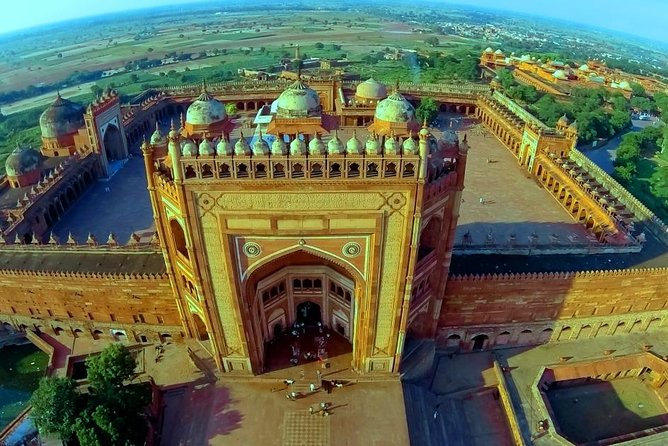
After the sunrise park visit, the route continues to Fatehpur Sikri, about two hours in the schedule. This red sandstone city was founded by a 16th-century Mughal emperor, and its central buildings include the Buland Darwaza gate and Jama Masjid mosque.
Fatehpur Sikri works well as a stop between Ranthambore and Agra because it breaks up the road journey while adding another major chapter of Mughal architecture. The buildings have a different feel from the white marble of the Taj Mahal and the red sandstone of Agra Fort, so the visit helps you see how varied imperial building styles could be.
The stop is listed without an included admission charge. You will also already have spent several hours in the park, so expect a full day. If you prefer slow museum visits and long lunches, this schedule may feel tight. If you want to see a lot in one week, it makes efficient use of the route.
Day 6: Sunrise at the Taj Mahal and Agra’s Mughal monuments
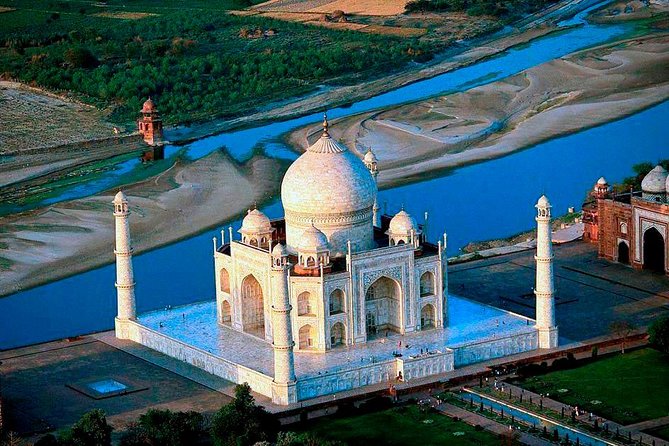
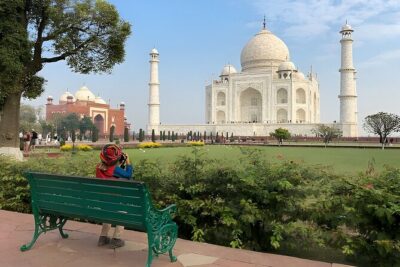
The Taj Mahal visit begins before breakfast at sunrise. This is exactly the right order. The early light gives the marble a changing tone, and the setting is generally more peaceful than the middle of the day. The monument was built by an emperor in memory of his beloved wife, and its power comes from both the design and the story attached to it.
The visit is scheduled for about two hours, with admission extra. Wear comfortable shoes and expect walking. The Taj Mahal is not a quick roadside stop, and the approach, grounds, and monument itself deserve unhurried attention even on a busy itinerary.
After breakfast and checkout, you visit Agra Fort, built by Emperor Akbar in 1565. The enormous red sandstone complex contains elegant buildings and gives useful context for the Mughal court that later produced the Taj Mahal. I would not treat it as a lesser version of the Taj. It has a different purpose and a stronger sense of military power.
Itmad-ud-Daula is often called a draft or early model for the Taj Mahal. Its smaller scale makes the detailed marble and inlay work easier to notice. The visit is followed by an Agra bazaar tour, where marble and soft-stone inlay are major handicrafts.
This is another day when the local guide matters. Agra’s monuments can blur together if you only collect photographs. A good explanation helps you connect the emperor, the architecture, the materials, and the people who built and decorated these places.
Day 7: Old Delhi, New Delhi, and the airport
The final day packs a great deal into the Delhi sightseeing schedule before your airport transfer. Jama Masjid, one of India’s largest mosques, was built by Shah Jahan between 1644 and 1656. The Red Fort was the Mughal emperors’ main residence for nearly two centuries and now includes museums.
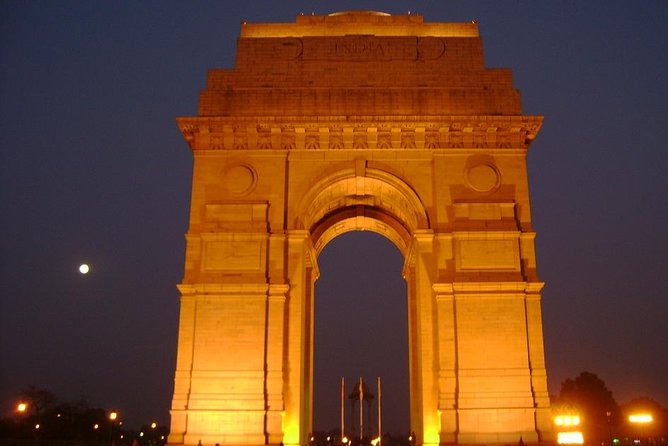
Raj Ghat, the memorial to Mahatma Gandhi, offers a quieter pause. India Gate is a war memorial on New Delhi’s ceremonial axis and is listed as a short stop. These two visits provide a change from imperial palaces and forts.
Humayun’s Tomb is one of the day’s major architectural visits. Commissioned by Empress Bega Begum after Humayun’s death, it was built in the 16th century and is listed as a UNESCO World Heritage site. The Lotus Temple, a Bahá’í House of Worship shaped like a flower, adds a modern religious landmark to the route.
The last stop is Qutub Minar, a tall minaret within the Qutb complex and another UNESCO World Heritage site. Admission is extra at many of these Delhi sights, so keep cash or payment arrangements in mind.
This final day is ambitious. If your flight leaves late, it may work well. If you have an early departure, you may not see every stop. Departure times and locations can vary slightly, so confirm the airport transfer after arrival and give yourself a safe margin.
Driving, hotels, and the overall pace
Transportation includes the car, tolls, parking, fuel, and driver allowances. That is a meaningful part of the price because the route covers several cities and rural stretches. A private vehicle also means you are not tied to a large group’s pace, though the drive times can still be tiring.
Six nights of accommodation and seven breakfasts are listed. The exact hotel names are not provided, and the accommodation differs between the three-star and four-star choices. Ask what your selected category includes, especially if the number of safaris is important to you.
The tour is private, meaning only your own group participates. Group discounts are available, which can improve the per-person value for families or friends traveling together. Most people can take part, but comfortable walking shoes are recommended and the route includes forts, monuments, stairs, outdoor areas, and early safari departures.
The booking is non-refundable and cannot be changed for any reason. That is a serious condition, so you should have your dates, passport details, and flight plans settled before paying.
Who should book this seven-day route?
I would choose this tour if you are visiting North India for the first time and want the major sights handled in one organized trip. It suits families, couples, and small groups who value a private vehicle and do not want to coordinate hotels, road transfers, guides, park fees, and airport pickups themselves.
It is less suitable if you want a slow holiday, long free periods, or a detailed Delhi stay. Delhi receives only the arrival night and a packed final sightseeing day. Jaipur and Agra receive more attention, while Ranthambore adds an early-morning wildlife element.
The strongest reasons to book are the combination of the Taj Mahal and Ranthambore, the private transport, and the included guides in Jaipur and Agra. The main reasons to hesitate are the extra monument fees, the demanding road schedule, the non-refundable terms, and the uncertainty of tiger sightings.
Should you book it?
Book this experience if you want a well-packed introduction to North India at a moderate starting price and you are comfortable paying extra for meals, monument tickets, tips, and personal expenses. Choose the four-star option if two included canter safaris are important to you.
Skip it if you prefer to linger in each city, dislike early mornings, or want a guaranteed wildlife encounter. For the right traveler, the route gives you India’s essential first chapters: Mughal Delhi, royal Jaipur, wild Ranthambore, and the Taj Mahal at sunrise.
FAQ
Where does the tour begin?
The tour begins with pickup at Indira Gandhi International Airport in New Delhi, India.
How long is the tour?
The experience lasts approximately seven days and includes six nights of accommodation.
Is this a private tour?
Yes. Only your own group participates in the tour or activity.
Are hotels and breakfast included?
Yes. Six nights of accommodation on double, twin, or triple sharing and seven breakfasts are included.
How many safaris are included in Ranthambore?
The three-star accommodation option includes one canter safari. The four-star option includes two canter safaris.
Are monument entrance tickets included?
Many monument entrance tickets are not included. The itinerary lists extra admission charges for several sights in Jaipur, Agra, and Delhi, including the Taj Mahal and Agra Fort.
Is Ranthambore National Park open all year?
The park is closed for some time from July 1 through September 30, depending on weather conditions. Check the operating dates before booking.
More 7-Day Experiences in New Delhi
- 7-Day Golden Triangle Tour with Ranthambore Tiger Safari
★ 5.0 · 53 reviews - 7-Day Golden Triangle & Varanasi Tour from Delhi with Guide
★ 5.0 · 38 reviews - 7 Day Golden Triangle Tour { Delhi Agra Jaipur Tour }
★ 5.0 · 23 reviews - 7 Days Golden Triangle Delhi,agra, Jaipur
★ 5.0 · 20 reviews
Newly reviewed around New Delhi
- Private Customized Tour Of Old/New Delhi Spiritual Sites★ 5.0 · 5 reviews
- Yoga and Meditation Classes in Gurgaon★ 4.5 · 8 reviews
- Yoga class in Delhi★ 5.0 · 29 reviews
- Old Town Delhi Walking Tour (2 Hours Guided Tour with Local)★ 4.5 · 22 reviews
- 5 Days Golden Triangle Tour with Ranthambore(Delhi Agra Jaipur Ranthambore Tour)★ 5.0 · 3 reviews
- Wonderful Old & New Delhi sightseeing tour★ 5.0 · 3 reviews
- Hidden Gems of Old Delhi – Walk★ 5.0 · 8 reviews
- Delhi Zoo White Tigers & lions with Old Fort Visit★ 4.5 · 5 reviews
Ranthambore Tiger Safari Tours from Delhi, compared.
Private 4-Day Golden Triangle Tour with Ranthambore Tiger Safari
Read our review →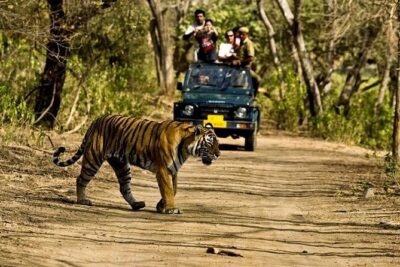
Private 5-Day Ranthambhore Tiger Tour from Delhi including the Taj Mahal, Agra and Jaipur
Read our review →
4 Day Golden Triangle with Ranthambore Tiger Safari Tour from Delhi
Read our review →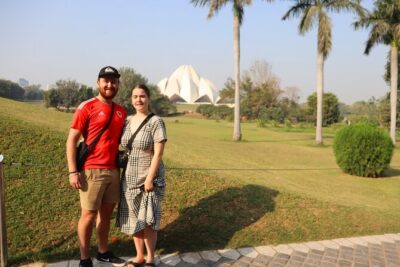
6 Days Delhi, Jaipur, Agra & Ranthambore By Car
Read our review →
4-Day Private Delhi, Agra & Jaipur with Ranthambore Tiger Safari
Read our review →
Private 6-Day Ranthambhore Tiger Tour including Delhi, Agra and Jaipur
Read our review →
7-Day Golden Triangle Tour with Ranthambore Tiger Safari
Read our review →
Ranthambhore Tiger Tour of Delhi, Agra, and Jaipur 5 Star Hotel
Read our review →Browse the lists this tour appears in