
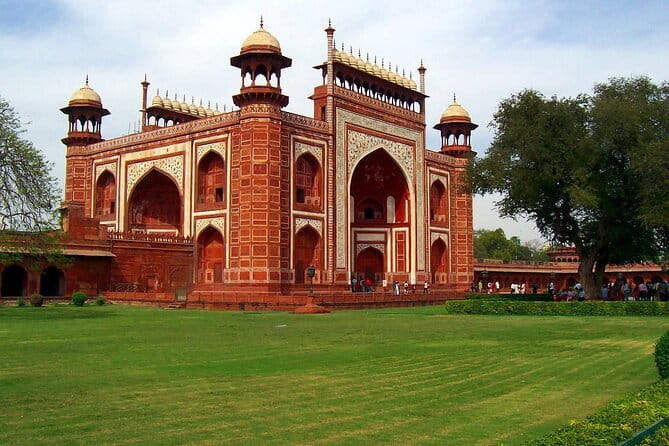
Reviewed · JAIPUR TOURS FROM DELHI
3-Day Golden Triangle Luxury Tour from Delhi to Agra and Jaipur
The Taj Mahal at sunrise is the great prize here, but the route gives you much more than one famous monument. In three days, you move from Delhi’s Mughal tombs and Old Delhi lanes to Agra’s imperial forts and Jaipur’s royal palaces. It is a brisk introduction to northern India, with a private car and guide keeping the complicated parts manageable.
I like two things in particular: the flexibility to change or remove monuments after booking, and the private transport between cities. I also like the practical touches, including bottled water, hotel pickup, a battery bus to the Taj Mahal entrance, and local guides in each city. The main drawback is pace. Three cities in three days means early mornings, long road transfers, and limited free time.
Key points to know before booking
- Sunrise at the Taj Mahal: You visit Agra’s defining monument early, with weather conditions affecting the exact plan.
- A private route, not a fixed group coach: Your own driver, air-conditioned vehicle, and private guides make timing and sightseeing more adaptable.
- Delhi’s sights fill the first day: Humayun’s Tomb, Qutub Minar, Lotus Temple, India Gate, Old Delhi, and more come before the drive to Agra.
- Jaipur gets a full sightseeing morning: Amber Palace, City Palace, Jantar Mantar, Hawa Mahal, and Jal Mahal are all included.
- Hotels are optional: The price starts at about $190.50 per person, but accommodation and some admission fees depend on the option you choose.
- The route changes on Thursdays: Since the Taj Mahal is closed on Fridays, Thursday departures run Delhi, Jaipur, Agra, and Delhi instead.
Why this three-day route works
India’s Golden Triangle is popular for a simple reason: the three cities show very different sides of the country within a short distance. Delhi is the broadest introduction, Agra delivers Mughal monuments at their grandest, and Jaipur brings in Rajput forts, pink-painted buildings, and royal observatories.
I would not call this a slow tour. It is designed for someone who wants to see the major sights without arranging several trains, taxis, hotels, and local guides alone. The private format matters most during transfers and city pickups. You are not waiting for a large bus to gather people from several hotels.
The route begins and ends in Delhi, Gurugram, or Noida. You can also finish at an airport, hotel, or another requested location in those areas. The final drive is expected to take about five hours, with arrival in Delhi around 9 p.m. unless you arrange a different timing.
More Jaipur trips from New Delhi:
- 3-Days Private Golden Triangle Tour: Delhi, Agra & Jaipur by Car
★ 5.0 · 1,107 reviews - 3-Days Private Golden Triangle Tour: Delhi, Agra & Jaipur by Car
★ 5.0 · 1,098 reviews - 3-Day Delhi, Agra and Jaipur Private Tour – India Golden Triangle
★ 5.0 · 812 reviews
Day one: Delhi’s monuments, markets, and Mughal remains
Pickup starts at your chosen location in Delhi, Gurugram, or Noida. The exact order and length of the day can change with traffic, but you should expect a full sightseeing schedule before the drive to Agra.
Humayun’s Tomb
This UNESCO-listed tomb is a fine opening stop. Built in 1569 for the Mughal emperor Humayun, it is an early example of the grand garden-tomb style later associated with the Taj Mahal.
You get about an hour here. That is enough to see the main structure and gardens with a guide, though not enough for a long, unhurried visit. The symmetrical setting also gives you useful context for Mughal design before you reach Agra.
Qutub Minar
The Qutub Minar complex brings a different architectural tradition. Its tall Afghan-style victory tower was begun by Qutb-ud-din in 1193, and the surrounding site adds carved stonework and older structures to the visit.
The minaret is the visual focus, but do not spend the whole stop looking straight up. I would use your guide to explain the complex as a whole. One hour is a reasonable first visit, though the admission fee is not included in the base itinerary.
More Golden Triangle routes from New Delhi:
- Four-Day Private Luxury Golden Triangle Tour to Agra and Jaipur From New Delhi
★ 5.0 · 807 reviews - 5 Nights 6 Days Private Golden Triangle Tour – Delhi Agra Jaipur
★ 5.0 · 574 reviews - 4 Days Golden Triangle Tour
★ 5.0 · 499 reviews - Private Car and Drive for Golden Triangle (4N/5D)
★ 5.0 · 451 reviews
Lotus Temple
The white, flower-shaped Lotus Temple offers a pause from the heavier monuments. It was designed for quiet worship, so the appeal is less about decoration inside and more about the building’s clean form and calm atmosphere.
The temple is closed on Mondays. If this stop matters to you, avoid a Monday departure or ask about the adjusted schedule before you pay. Admission is not included.
India Gate, Rashtrapati Bhavan, and Parliament House
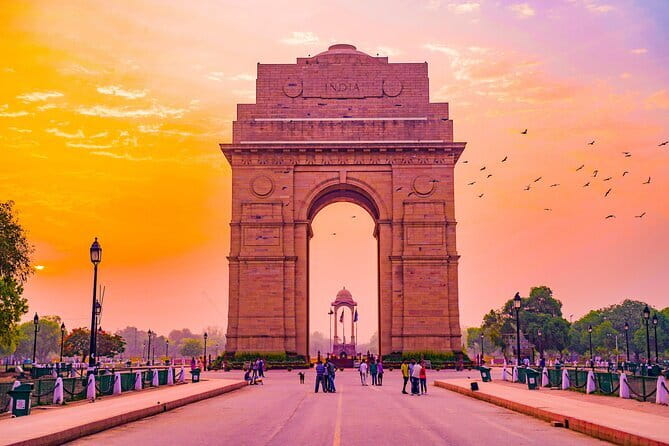
These three stops are brief, usually about 15 minutes each. India Gate is a 42-meter memorial arch honoring Indian soldiers who died in World War I, the Northwest Frontier operations, and the 1919 Anglo-Afghan War.
Rashtrapati Bhavan, the President of India’s official residence, was formerly the British Viceroy’s home. Parliament House, with its circular colonnade, links the colonial capital to independent India, including the 1947 transfer of power.
Think of these as orientation stops rather than full visits. You will mostly see the buildings from outside, take photographs, and continue.
Agrasen Ki Baoli
This protected stepwell is one of Delhi’s more unusual stops. The long, narrow structure descends through layers of stone steps and shows how water collection once shaped urban life.
You have about 30 minutes here. It is a welcome change from the grand tombs and government buildings, and it works well as a short walk before the Old Delhi portion of the day.
Chandni Chowk and the rickshaw ride
Old Delhi is where the day becomes more sensory. Chandni Chowk is packed with spice shops, dried fruit, silver jewelry, saris, oils, and narrow lanes lined with small businesses.
A 30-minute rickshaw ride is included. This gives you a quick look at the area without asking you to navigate it alone. The ride is short, so treat it as an introduction rather than a full market visit.
The Red Fort is also part of the Delhi route, though the schedule gives less detail about the length of that stop. It was the Mughal emperors’ main residence for nearly two centuries and now contains museums. If you care strongly about entering the fort, confirm the timing and admission arrangement with the operator.
The road to Agra
After lunch at a local restaurant, you take the Yamuna Expressway toward Agra. The drive is listed at roughly three hours, though traffic can change that.
This is the first major tradeoff of the tour. You cover a lot of ground in one day, but you will likely feel ready for a quiet evening by the time you reach the hotel. Check-in is followed by free time, with an overnight stay in Agra.
Day two: the Taj Mahal, Agra Fort, and the road to Jaipur
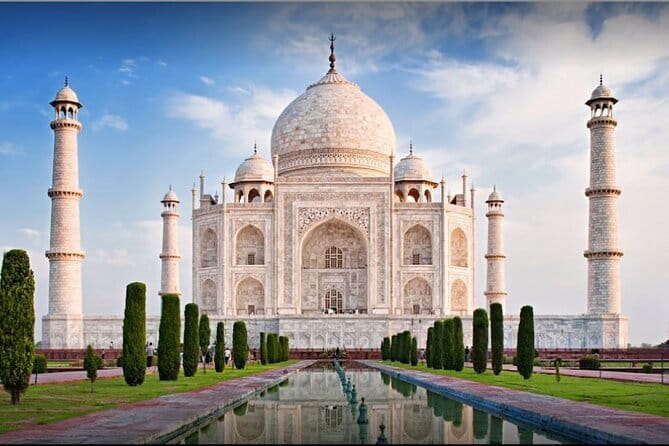
Day two starts early. The sunrise visit to the Taj Mahal is the emotional center of the tour, and the early departure is worth accepting if you want softer light and cooler conditions. The visit is subject to weather, so the exact experience can vary.
Taj Mahal at sunrise
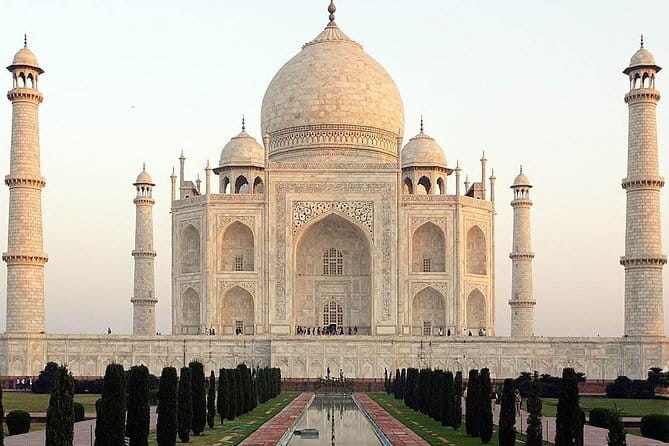
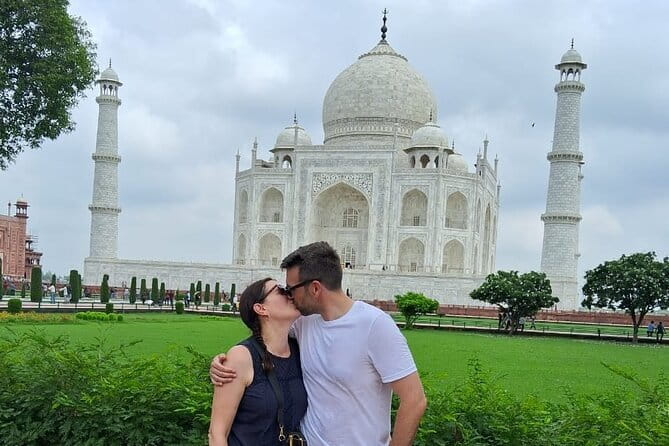
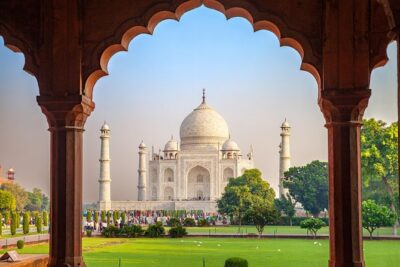
You have about two and a half hours at the Taj Mahal. That is enough time to approach the monument, walk through the grounds, take photographs, and listen to your guide explain the mausoleum’s story.
The Taj Mahal was built by Emperor Shah Jahan in the 17th century as a mausoleum. Its pale marble changes with the light, and seeing it early gives the visit a quieter, more reflective quality than arriving in the middle of the day.
A battery bus or golf cart takes you from the parking area to the entrance and back. Admission is listed separately from the basic tour price, so check the exact booking option. Wear comfortable shoes, since the visit involves walking and standing even with the parking transfer.
Agra Fort
Agra Fort is not just a defensive wall. It was the main residence of Mughal emperors until 1638, and its courtyards, halls, and river-facing views help explain how imperial life worked.
The planned visit lasts about 90 minutes. I like this pairing with the Taj Mahal because the two sites show different sides of Mughal power: one is a carefully composed tomb, the other a working royal complex.
Itmad-ud-Daula, the Baby Taj
The tomb of Itmad-ud-Daula is smaller than the Taj Mahal but rewarding for its detail. It is surrounded by gardens and other structures, and its nickname, Baby Taj, gives you a useful sense of its scale.
You have about an hour here. Do not expect the same monumental impact as the Taj Mahal. Instead, look for the finer decoration and the quieter setting. The admission fee is not included in the base itinerary.
Chand Baori at Abhaneri
The journey toward Jaipur includes Chand Baori, an enormous stepwell dating from the eighth or ninth century. Its 3,500 steps form a striking geometric pattern down toward the water.
The stop lasts about an hour and breaks up the transfer between Agra and Jaipur. It is also one of the most distinctive places on the route, especially for anyone interested in engineering, water systems, and everyday life beyond palaces and tombs.
Jaipur arrival
The drive to Jaipur is listed at about five hours, including the route from Agra and the stop at Abhaneri. After checking into your Jaipur hotel, the evening is free.
That free time is useful, but do not assume you will have a full night to explore. The next morning includes several major sights, and the final trip back to Delhi is long.
Day three: Jaipur’s forts, palaces, and observatory
Jaipur’s sightseeing begins with short photo stops, followed by longer visits at the city’s principal monuments. The city offers a different mood from Delhi and Agra, with Rajput architecture, royal residences, and planned ceremonial spaces.
Hawa Mahal
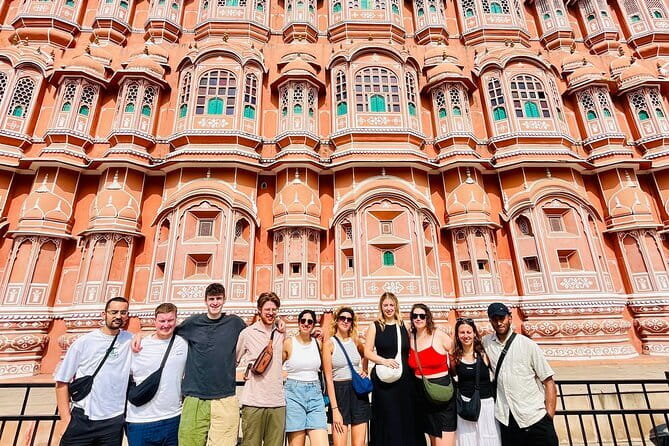
The Palace of Winds is Jaipur’s most recognizable facade. Its pink, honeycombed front rises five stories and was built in 1799 by Maharaja Sawai Pratap Singh.
The scheduled stop is only 15 minutes and is described as a photo stop. That is enough to see the exterior and take in the unusual windows, but not enough for a lengthy interior visit. If you want more time, ask if the schedule can be adjusted.
Panna Meena ka Kund
This 16th-century stepwell is known for its symmetrical staircases and central well. The stop lasts about 15 minutes, so you will mainly view the structure and take photographs.
It is a small stop, but it pairs nicely with Chand Baori from the day before. Together, the two wells show how practical water architecture could also produce strong geometric designs.
Amber Palace
Amber Palace is the major Jaipur visit, with about two hours planned. This UNESCO-listed complex includes fortifications, marble details, and mirrored interiors, with views connected to the surrounding hills.
I would save your energy for this stop. The palace is large enough that a rushed visit would miss much of its value, and the uneven surfaces make sensible shoes important. Admission is not included in the basic price.
Jal Mahal
The Water Palace is a brief photo stop beside Man Sagar. The palace sits in the water, so you will mainly view it from the shore rather than tour the building.
Fifteen minutes is enough for photographs, but not for a long visit. It is best treated as a scenic pause between Amber Palace and the city-center sights.
City Palace
The City Palace was built in 1721 as the administrative and ceremonial seat of Jaipur’s Maharaja. It remains one of the best places on this route to connect royal ceremony with daily governance.
You have about an hour here. The complex can feel dense with courtyards, rooms, and decorative details, so your private guide is especially useful for explaining what you are looking at rather than leaving you to read signs quickly.
Jantar Mantar
Jantar Mantar is a UNESCO-listed observatory made up of large geometric instruments designed to track the movement of stars and planets.
The visit lasts about an hour. It is a good final monument because it shifts the focus from palaces and warfare to mathematics and astronomy. Some of the instruments are easier to appreciate with an explanation, so listen closely to the guide’s interpretation.
The private car, guides, and hotel choices
The tour uses a private air-conditioned vehicle throughout. One or two people receive a four-seat sedan, three or four people travel in a six-seat MPV, and groups of five to ten use a ten-seat van.
That range matters. A private car does not make the road distances disappear, but it gives you personal space and avoids the stop-and-start feel of a large group vehicle. The driver is listed as fully vaccinated, and private guides are provided for the excursions.
Two nights of accommodation with breakfast are included only if you select the hotel option. Rooms are generally twin-sharing. Three people receive a triple room by default, while two rooms for three people require an extra charge.
You can also book without hotels and arrange your own accommodation. The first night is in Agra and the second in Jaipur, so choose locations that make pickup and morning departures easy.
Is the $190.50 starting price good value?
At about $190.50 per person, the starting price can be attractive for a private three-day route, but you need to check what your selected option includes. Accommodation may be optional, and entrance fees are listed separately for many major sights.
The value comes from the combination of private transport, driver, guides, hotel pickup and drop-off, bottled water, breakfast when hotels are included, and the amount of ground covered. Organizing the same route independently would require you to arrange intercity transport, local guides, hotel transfers, and timing at several monuments.
Do not compare the price only with a basic bus tour. Compare it with the cost of arranging a private car and multiple guides. At the same time, add the entrance fees and confirm the hotel category before assuming the word luxury means five-star accommodation. A five-star hotel option is available, but the supplied details do not state that every booking includes it.
Small details that make a big difference
The tour offers free cancellation up to 24 hours before the start time. After that cutoff, changes and refunds are not accepted.
Bring a current passport. Wear comfortable walking shoes, especially for the Taj Mahal, Agra Fort, Amber Palace, and the stepwells. The exact transfer times depend on traffic and time of day, so avoid booking a tight onward connection after the final five-hour drive.
The itinerary can be changed after booking. You can ask to add, remove, or replace a monument, which is useful if you have already seen one of Delhi’s major sights or want more time at the Taj Mahal.
The schedule also needs careful attention around weekdays. Lotus Temple is closed on Mondays, and the Taj Mahal is closed every Friday. A Thursday departure reverses the order to Delhi, Jaipur, Agra, and Delhi so the Taj Mahal can be visited when it is open.
Who should book this Golden Triangle tour?

I would choose this tour if you have only three days and want the main sights handled by one provider. It suits first-time visitors, families, couples, and small groups who value a private vehicle and do not want to manage the road route themselves.
It also works well for an anniversary or family trip. The private setup gives you more control than a standard group tour, and the included planning covers the awkward transitions between cities.
I would think twice if you prefer slow travel, long meals, independent wandering, or several hours at every monument. Delhi alone can fill several days, and Jaipur deserves more time than a single morning if you want markets, museums, and relaxed exploration.
Should you book it?
Book this tour if your priority is maximum sightseeing in minimum time. The Taj Mahal sunrise, Agra Fort, Amber Palace, Jaipur’s royal center, and Delhi’s major monuments make a strong first visit to northern India.
Before paying, confirm four things: the hotel category, which admission fees are included in your chosen option, the weekday route, and your final drop-off time. If you accept the early starts and long drives, the private car, local guides, and adjustable itinerary make this a practical way to see the Golden Triangle without handling every detail yourself.
FAQ
Is this a private tour?
Yes. Only your group participates, with a private driver, air-conditioned vehicle, and private guides for the excursions.
Where can pickup and drop-off take place?
Pickup and drop-off are available at requested locations in Delhi, Gurugram, or Noida. The final drop-off can also be arranged at an airport, hotel, or another desired location in those areas.
Are the hotels included?
Hotels are included only when you select the option that includes accommodation. That option provides two nights with breakfast. You can also book without hotels and arrange your own rooms in Agra and Jaipur.
Are entrance fees included?
Many attraction entries are listed as not included, including the Taj Mahal, Qutub Minar, Humayun’s Tomb, Agra Fort, Amber Palace, City Palace, Jantar Mantar, and other monuments. Check the exact option before booking because the tour information also describes entrance fees as optional.
Is the Taj Mahal visited at sunrise?
Yes. The plan includes a sunrise visit lasting about two and a half hours. The sunrise visit is subject to weather conditions.
What happens if the tour starts on a Thursday?
The route changes to Delhi, Jaipur, Agra, and Delhi because the Taj Mahal is closed every Friday. This allows the Taj Mahal visit to take place when it is open.
Is the Lotus Temple open every day?
No. Lotus Temple is closed every Monday. Plan around this if you want to visit it.
What type of vehicle is used?
One or two people travel in a four-seat sedan, three or four people in a six-seat MPV, and five to ten people in a ten-seat van. All vehicles are air-conditioned.
More 3-Day Experiences in New Delhi
- 3-Day Private Luxury Golden Triangle Tour to Agra and Jaipur From New Delhi
★ 5.0 · 424 reviews - 3-Day Luxury Golden Triangle Tour: New Delhi, Agra & Jaipur
★ 5.0 · 246 reviews - Award-Winning 3-Day Private Golden Triangle Tour of India
★ 5.0 · 240 reviews - 3-Day Private Golden Triangle Tour to Agra &Jaipur from New Delhi
★ 5.0 · 116 reviews
More Agra Tours from New Delhi
- Same Day Taj Mahal, Agra Fort & Baby Taj Tour from Delhi by Car
★ 5.0 · 4,304 reviews - Full Day Taj Mahal, Agra Fort & Baby Taj Tour from Delhi by Car
★ 5.0 · 3,647 reviews - From Delhi: Taj Mahal & Agra Private Day Trip with Transfers
★ 4.9 · 3,181 reviews - From Delhi: Taj Mahal and Agra Fort Private Sunrise Tour
★ 4.9 · 2,270 reviews
Newly reviewed around New Delhi
- Private Customized Tour Of Old/New Delhi Spiritual Sites★ 5.0 · 5 reviews
- Yoga and Meditation Classes in Gurgaon★ 4.5 · 8 reviews
- Yoga class in Delhi★ 5.0 · 29 reviews
- Old Town Delhi Walking Tour (2 Hours Guided Tour with Local)★ 4.5 · 22 reviews
- 5 Days Golden Triangle Tour with Ranthambore(Delhi Agra Jaipur Ranthambore Tour)★ 5.0 · 3 reviews
- Wonderful Old & New Delhi sightseeing tour★ 5.0 · 3 reviews
- Hidden Gems of Old Delhi – Walk★ 5.0 · 8 reviews
- Delhi Zoo White Tigers & lions with Old Fort Visit★ 4.5 · 5 reviews
Jaipur Tours from Delhi, compared.
3-Days Private Golden Triangle Tour: Delhi, Agra & Jaipur by Car
Read our review →3-Days Private Golden Triangle Tour: Delhi, Agra & Jaipur by Car
Read our review →
3-Day Delhi, Agra and Jaipur Private Tour – India Golden Triangle
Read our review →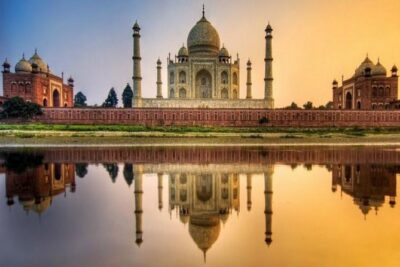
Four-Day Private Luxury Golden Triangle Tour to Agra and Jaipur From New Delhi
Read our review →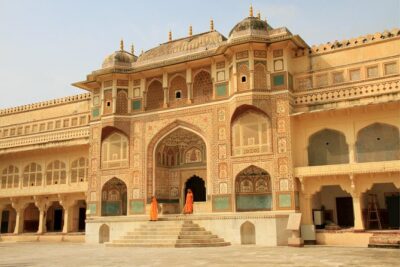
Jaipur Day Trip from Delhi by Car or Train – All Inclusive
Read our review →
Jaipur City Private Day Tour from Delhi by Car – All Inclusive
Read our review →
5 Nights 6 Days Private Golden Triangle Tour – Delhi Agra Jaipur
Read our review →
Private Golden Triangle Tour Delhi Agra Jaipur ( Top Rated )
Read our review →Browse the lists this tour appears in