
Reviewed · NEW DELHI CITY TOURS
Private City Tour to Old and New Delhi
Delhi’s past comes at you in layers on this private tour: Mughal forts, Sultanate towers, British-era monuments, modern temples, and a quiet garden all fit into one long day. The best part is the private car, which lets your group adjust the pace instead of trailing behind a large bus.
I like the broad mix of Old and New Delhi, and I like that the price is $65 per group of up to five, not $65 per person. The main catch is that admission fees are extra, and fitting all eight stops into four to eight hours means you may need to choose between a quick look and a proper visit.
Key points at a glance
- Eight major stops: The route covers Qutub Minar, Humayun’s Tomb, Lotus Temple, India Gate, Red Fort, Jama Masjid, Akshardham, and Lodhi Garden.
- A private ride for up to five: Your group has its own air-conditioned vehicle, with bottled water included.
- Good value for a small group: The $65 rate is charged per group, though entrance fees are listed separately at $50 for two people.
- A useful Old Delhi and New Delhi split: You see Mughal landmarks, imperial avenues, religious buildings, and a modern Hindu temple in one outing.
- Flexible length: The tour is advertised at about four to eight hours, so the pace and number of interior visits matter.
- Strong service focus: Ashok and his team are associated with polite English-speaking drivers, dependable transport, and local restaurant and shopping suggestions.
Why this route gives you a real sense of Delhi
Delhi is not one tidy historic center. It is a collection of capitals built by different rulers, joined by wide roads, crowded lanes, government districts, residential areas, and layers of daily life. This tour works because it shows that contrast instead of limiting you to one monument.
You begin from Connaught Place, a practical central meeting point, then move south toward the older Sultanate monuments before crossing into Mughal, British, and modern Delhi. Later, the route turns toward Old Delhi, where the Red Fort and Jama Masjid anchor the visit.
That sounds simple on paper. Delhi traffic can make short distances take time, so the private vehicle matters. You are not left figuring out several taxi rides or public transport connections between widely separated sights. The air conditioning and included bottled water are small comforts, but they count in Delhi’s heat and dust.
The schedule also needs a realistic reading. The listed stop times add up to around six and a half hours before driving, meals, queues, and security checks. A four-hour version would have to be a highlights tour with several photo stops. An eight-hour version gives you a better chance to enter the paid monuments and spend time inside.
More New Delhi city tours:
- Old & New Delhi City Tour – Half or Full Day Options Available
★ 5.0 · 4,811 reviews - Old & New Delhi Private Tour – Half or Full Day (Rated Excellent)
★ 5.0 · 2,226 reviews - Old & New Delhi Full or Half Day Sightseeing Tour
★ 5.0 · 1,900 reviews
Qutub Minar and the first layer of Delhi
Qutub Minar is the tour’s oldest major monument. Built in the early 13th century, it began under Qutub-ud-din Aibak, founder of the Delhi Sultanate, and was completed and altered by later rulers.
The red sandstone and marble tower rises 73 meters, with a broad base that narrows sharply toward the top. Its fluted shafts, carved bands, and Indo-Islamic Afghan design make it easy to understand why this is one of Delhi’s signature sights.
Allow about an hour here. The complex is not only about the tower. The Iron Pillar is another major attraction, and the surrounding remains help you see Qutub Minar as part of a larger royal and religious site rather than an isolated column.
Admission is not included, so budget for it before you arrive. If you are trying to keep the outing near four hours, this is one place where you may be tempted to stay only for photographs. I would not rush it. The complex gives you your first clear look at Delhi’s Sultanate period, which is easy to miss when a city tour focuses only on the Mughal monuments.
Humayun’s Tomb, the Mughal preview
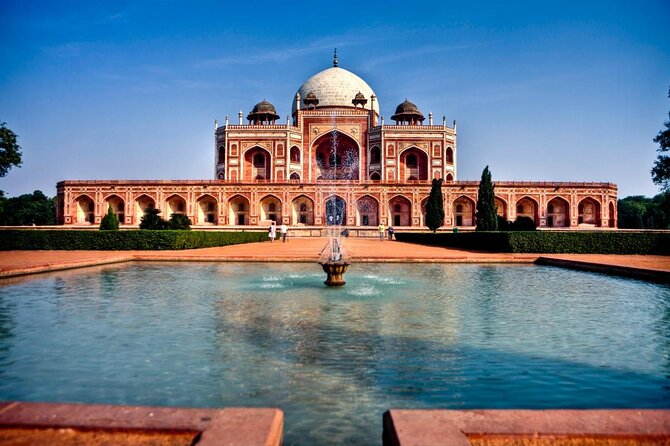
Humayun’s Tomb shifts the story forward to the Mughal period. Commissioned by Empress Bega Begum after the death of Emperor Humayun, the tomb was completed in 1572.
The building combines Persian and Indian design, with a formal garden setting and a large central dome. Its strong symmetry makes it a calmer stop than the traffic outside, and the structure offers a useful introduction to Mughal design before you reach the Red Fort.
The tomb is often described as a forerunner to the Taj Mahal. That comparison is helpful, but the building deserves attention on its own. You can see the large-scale planning and formal geometry that later became closely associated with Mughal architecture.
Plan on an hour, plus the separate admission fee. If your time is limited, this is a better place to spend time inside than India Gate, which is mainly an exterior monument. Wear comfortable shoes, since the visit involves walking through the grounds.
Lotus Temple and a quiet pause
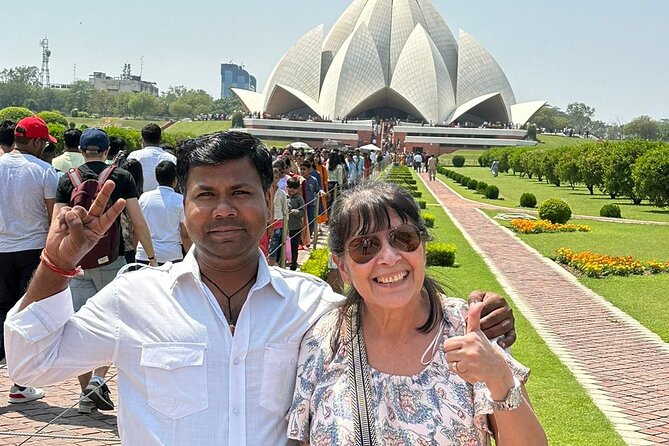
The Lotus Temple offers a sharp change in mood and style. Completed in 1986, this Bahá’í House of Worship is shaped like a white marble lotus and surrounded by gardens.
The temple is open to people of all faiths. Inside, the purpose is prayer and meditation, so silence is expected. This is a short stop of about 30 minutes, and admission is free.
I like this part of the route because it breaks up the succession of forts and tombs. You are not simply moving from one historic structure to another. You are also seeing how modern Delhi presents a place of worship designed for everyone.
The short timing means you should treat it as a focused visit, not a long architectural tour. If the temple is busy, the visit may feel brief. Still, its shape is memorable, and the quiet interior provides a welcome pause in a full sightseeing day.
A few more New Delhi day trips worth putting side by side
- From Delhi: Taj Mahal & Agra Private Day Trip with Transfers
★ 4.9 · 3,181 reviews - All Inclusive Private Taj Mahal Luxury Tour from Delhi by Car
★ 5.0 · 2,564 reviews - From Delhi: Taj Mahal and Agra Fort Private Sunrise Tour
★ 4.9 · 2,270 reviews - Taj Mahal and Agra Private Car Tour from Delhi with 5* Lunch
★ 5.0 · 1,633 reviews
India Gate and the ceremonial center
India Gate is a 42-meter war memorial built to honor soldiers of the Indian Army who died in World War I. Its foundation stone was laid in 1921, and the monument was completed in 1931.
The arch is made from red and yellow sandstone and was influenced by Paris’s Arc de Triomphe. Names of soldiers are inscribed on the structure, giving the monument a purpose beyond its familiar photo appeal.
The stop lasts about 30 minutes and is free. That is enough for photographs, a walk around the base, and a look at the surrounding ceremonial district. The Amar Jawan Jyoti, an eternal flame at the base, adds a solemn note.
This is a good exterior stop when you need to keep moving. You do not need an hour here to understand the monument. The tradeoff is that you will not get the same interior experience you receive at a tomb or fort, so the value depends on whether you want a broad city overview or more time at fewer sites.
Red Fort, the Mughal seat of power
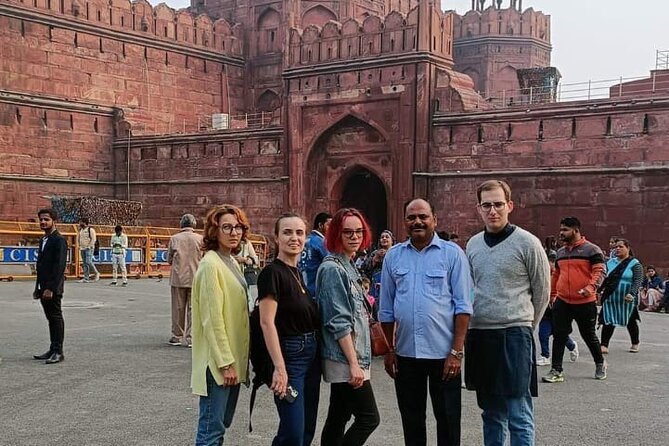
Red Fort is one of the day’s major anchors. Mughal emperor Shah Jahan began construction in 1638, and the fort was completed in 1648. It served as the main home of the Mughal emperors for nearly two centuries.
Its red sandstone walls are impressive from the outside, but the interior spaces explain the fort’s role better. The Diwan-i-Aam was used for public audiences, while the Diwan-i-Khas was reserved for more private meetings. White marble inlays and a blend of Persian, Timurid, and Indian design show the courtly world that once operated here.
Allow about an hour, with admission extra. This is one stop where a guide can add real value by explaining how the public and private parts of the palace worked. If you enter late in the day, check how much time remains for the main halls rather than assuming a quick walk around the walls will cover everything.
Red Fort can also be the point where the schedule becomes tight. It is tempting to linger, especially after seeing Qutub Minar and Humayun’s Tomb. If those earlier sites took longer than planned, you may need to shorten a later garden or exterior stop.
Jama Masjid and Old Delhi on foot
Jama Masjid brings you into the heart of the Old Delhi section. Shah Jahan commissioned the mosque, construction began in 1650, and it opened in 1656.
The mosque uses red sandstone and white marble, with broad steps, large gateways, and a design that combines Persian, Timurid, and Indian elements. Its main entrance, the Buland Darwaza, is particularly imposing.
The planned visit is about 30 minutes, and admission is not included. That is enough to see the scale of the courtyard and the main architectural details, but it is not a long neighborhood exploration. Dress and behavior should be respectful at this active religious site, and follow any instructions given at the entrance.
This stop is valuable because it puts the Mughal story into a living part of the city. You are not only looking at a former royal building. You are seeing a mosque that remains a place of worship. The surrounding Old Delhi area also gives you a stronger sense of the city’s crowded, energetic character than the formal roads around India Gate.
Akshardham and the rules that shape the visit
Swaminarayan Akshardham is the tour’s most recent major religious site. It opened in 2005 and was built by the BAPS organization. The central mandir is dedicated to Bhagwan Swaminarayan and includes 234 carved pillars, nine domes, and more than 20,000 statues of Hindu divine figures.
The planned visit is about 90 minutes, making it the longest stop on the route. The scale and detailed carving are the main reasons to allow that time.
Security rules are strict. Bags, cameras, and electronic devices are not allowed inside the temple complex, and a secure storage facility is provided. This is an important practical point: do not plan on taking interior photographs or carrying your usual day bag through the site.
Admission is extra. Because of the security process and the size of the complex, Akshardham is not an easy stop to squeeze into a rushed half-day schedule. If you want to include it properly, choose the longer version of the tour and accept that another stop may receive only a brief visit.
Lodhi Garden and a softer finish
Lodhi Garden offers a change from grand monuments and formal religious buildings. The 90-acre garden contains tombs and monuments from the Lodhi Dynasty, which ruled parts of northern India in the 15th and 16th centuries.
You can spend about 30 minutes walking among lawns, trees, flower beds, and historic structures. The garden is used by local people for walking and jogging, so it gives you a glimpse of ordinary city life alongside the old tombs.
This is a free stop and a smart way to slow the day down. It may not be the first priority for someone with only four hours, but it is worthwhile on the longer route. I would choose it over another rushed photo stop if you want a break from traffic and stone walls.
What the $65 price really buys
At $65 per group of up to five, the tour can be good value for a family or small group. Two people effectively share the vehicle cost, while five people bring the per-person price down sharply. The price includes an air-conditioned vehicle and bottled water.
The important catch is the admissions. Entrance fees are listed separately at $50 for two people. Since several stops charge admission, your final cost will be higher than the headline price. Ask for a clear breakdown before the day if you are comparing this with other private tours.
The value is mainly in the private transport and the range of sights. You are paying to connect Qutub Minar, southern Delhi, central Delhi, Old Delhi, and Akshardham without arranging each ride yourself. You are not paying for an all-inclusive ticket package.
The service style appears to center on Ashok and his driving team. Names associated with past arrangements include Harish, Raj, and Anants, but your booking does not identify which driver will be assigned. The useful pattern is clear: drivers are described as polite, English-speaking, punctual, and willing to suggest local food or shopping. Treat those extras as possible help, not guaranteed parts of the published route.
Timing, pickup, and practical planning
Pickup is offered, but the stated starting point is Connaught Place, New Delhi. The tour ends back at the meeting point. Confirm the exact pickup arrangement when booking, especially if you are staying outside central Delhi.
The advertised duration is four to eight hours. That range is wide because the route has eight stops, driving time, paid-entry queues, security at Akshardham, and possible traffic delays. A full version is closer to a substantial day than a quick city orientation.
The supplied operating information shows Monday hours from 10:00 a.m. to 4:00 p.m. Check the current schedule before booking, since the monument schedule and the tour’s operating hours need to match. Confirmation is provided at booking, and the activity is near public transportation.
Most people can participate, and this is a private activity for your own group. Free cancellation is available until 24 hours before the start time. Changes or cancellations made inside that window are not accepted for a refund.
Who should book this Delhi tour?
I would choose this tour if you want a broad first look at Delhi, prefer a private car, and are traveling with two to five people. It is also useful if you have limited time and want the major landmarks arranged in one outing rather than pieced together yourself.
Families and small groups get the strongest value from the flat group price. You can also use the private format to decide whether to linger at Humayun’s Tomb or move quickly through India Gate.
I would be more cautious if you want long, detailed visits at every site. Eight stops are a lot, and the four-hour option cannot deliver the same experience as the eight-hour version. If you care most about history and interiors, ask in advance how the guide will handle the schedule and which entrance fees apply.
Should you book it?
Book it if you want efficient coverage, private transport, and a flexible Old Delhi and New Delhi route at a sensible group price. The best version is the longer one, with enough time for Qutub Minar, Humayun’s Tomb, Red Fort, Jama Masjid, and Akshardham.
Skip it if you would rather explore one neighborhood slowly or if extra entrance fees will push the total beyond your budget. For a first Delhi visit, though, this tour gives you a useful framework: Sultanate tower, Mughal tomb, imperial memorial, Old Delhi mosque, modern Hindu temple, and a peaceful historic garden, all linked by one driver.
FAQ
How much does the private Delhi city tour cost?
The tour costs $65 per group of up to five people. Entrance fees are not included, and the listed entrance cost is $50 for two people.
How long does the tour last?
The experience lasts approximately four to eight hours. The exact pace depends on traffic, time spent at each stop, and which sites you enter.
What attractions are included in the route?
The route includes Qutub Minar, Humayun’s Tomb, Lotus Temple, India Gate, Red Fort, Jama Masjid, Swaminarayan Akshardham, and Lodhi Garden.
Is transportation included?
Yes. An air-conditioned vehicle and bottled water are included. Pickup is offered, and the tour begins and ends at the stated meeting point in Connaught Place.
Are entrance tickets included?
No. Admission tickets are not included for Qutub Minar, Humayun’s Tomb, Red Fort, Jama Masjid, or Swaminarayan Akshardham. Lotus Temple, India Gate, and Lodhi Garden are listed as free.
Can I bring a camera or bag to Akshardham?
No. Bags, cameras, and electronic devices are not allowed inside the Akshardham complex. A secure storage facility is available for belongings.
What is the cancellation policy?
You can cancel up to 24 hours before the experience for a full refund. Cancellations or changes made less than 24 hours before the start time are not accepted for a refund.
Newly reviewed around New Delhi
- Private Customized Tour Of Old/New Delhi Spiritual Sites★ 5.0 · 5 reviews
- Yoga and Meditation Classes in Gurgaon★ 4.5 · 8 reviews
- Yoga class in Delhi★ 5.0 · 29 reviews
- 5 Days Golden Triangle Tour with Ranthambore(Delhi Agra Jaipur Ranthambore Tour)★ 5.0 · 3 reviews
- Wonderful Old & New Delhi sightseeing tour★ 5.0 · 3 reviews
- Old Town Delhi Walking Tour (2 Hours Guided Tour with Local)★ 4.5 · 22 reviews
- Hidden Gems of Old Delhi – Walk★ 5.0 · 8 reviews
- Delhi Zoo White Tigers & lions with Old Fort Visit★ 4.5 · 5 reviews
New Delhi City Tours, compared.

Old & New Delhi City Tour – Half or Full Day Options Available
Read our review →
Old & New Delhi Private Tour – Half or Full Day (Rated Excellent)
Read our review →
Old & New Delhi Full or Half Day Sightseeing Tour
Read our review →

Old & New Delhi Private City Tour – Traveler’s Choice (Top Rated)
Read our review →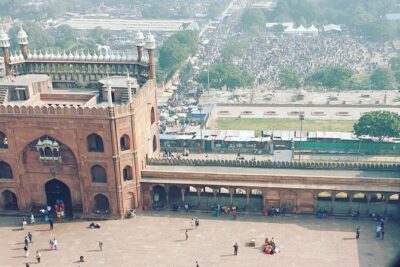

Private Old and New Delhi City Full Day or Half Day Tour
Read our review →
Old and New Delhi Full Day or Half Day Tour – Best of Delhi City
Read our review →Browse the lists this tour appears in