Reviewed · PRIVATE
5 Hour Private Tour in British Delhi
British Delhi is best understood as a walk through layers: grand government buildings, a war memorial, a 14th-century stepwell, a working laundry, old sweets shops, and a Hindu temple. This private tour links those pieces in one compact outing, with an air-conditioned vehicle between stops. Agrasen Ki Baoli is the surprise here, a quiet stone stepwell tucked into central Delhi’s busy streets.
I like the mix of famous sights and ordinary city life. Hailey Road’s dhobi ghat gives you a look at hand-washing work, while Bengali Market adds traditional sweets and Delhi snacks to the day. I also like the private format, since you can ask questions and set the pace more easily than in a large group.
The main drawback is timing. Eight listed stops in four to five hours means some visits will be brief, and Connaught Place, Bengali Market, or the temple can feel rushed if traffic slows the vehicle. Lunch is not included, so plan to buy food at Bengali Market or eat separately.
Key points at a glance
- British-era Delhi in one short tour: See Rashtrapati Bhavan, Parliament House, India Gate, colonial residences, and Connaught Place.
- Agrasen Ki Baoli adds real variety: This 14th-century stepwell offers a sharp contrast to the grand avenues of New Delhi.
- A working dhobi ghat keeps the tour grounded: Hailey Road shows hand-washing laundry rather than only polished monuments.
- Bengali Market is your food stop: Look for traditional sweets, bakery items, and everyday Delhi shops.
- Private transport makes the route practical: Air-conditioning, bottled water, and onboard WiFi are included.
- Raj may be your guide: Raj is specifically associated with the experience, and his clear explanations and friendly manner are highlighted in the available feedback.
Why this short tour works for first-time Delhi visitors
This experience focuses on central New Delhi, but it does not treat the city as a row of official buildings. You begin with the power center created under British rule, then move through memorial architecture, an older water structure, working-class daily life, food, shopping, and religion.
That range matters. If you only visit Rashtrapati Bhavan and India Gate, you see the formal face of Delhi. If you add Agrasen Ki Baoli, the dhobi ghat, Bengali Market, and the Hanuman temple, you get a more useful sense of how old and modern parts of the city sit together.
The private setup suits you if you want direct explanations. Raj is the guide named in the available feedback, and his strengths are described as clear explanations, strong knowledge of Delhi and India, and a warm manner. Guide assignments can vary, so ask about Raj when booking if that matters to you.
The vehicle is not just a comfort feature. Delhi traffic can make short distances take time, particularly around central commercial areas. An air-conditioned car gives you a break between stops, and two branded mineral-water bottles per person are included. WiFi is also provided onboard.
A few more New Delhi day trips worth putting side by side
- From Delhi: Taj Mahal & Agra Private Day Trip with Transfers
★ 4.9 · 3,181 reviews - All Inclusive Private Taj Mahal Luxury Tour from Delhi by Car
★ 5.0 · 2,564 reviews - From Delhi: Taj Mahal and Agra Fort Private Sunrise Tour
★ 4.9 · 2,270 reviews
Rashtrapati Bhavan and the formal face of Delhi
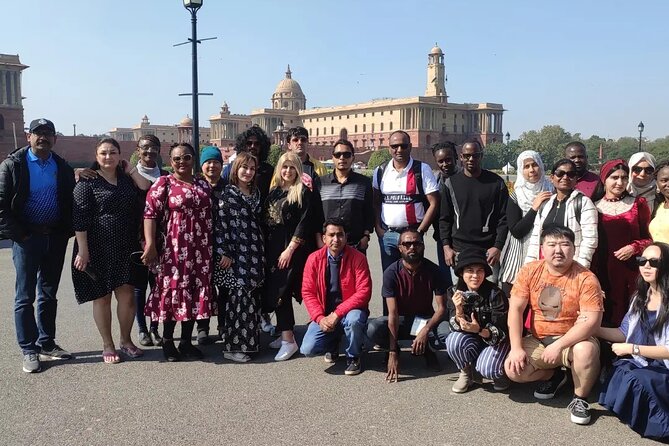
The tour begins at Rashtrapati Bhavan, the official residence of the President of India. The building was created between 1911 and 1929 by architects Edwin Lutyens and Herbert Baker, and its scale helps explain the ambition of the British plan for New Delhi.
Expect this stop to take about 30 minutes. You will mainly be looking at the exterior architecture and the surrounding government district rather than spending hours inside the residence. The value is in seeing the building in context, as part of a carefully planned administrative center.
The design combines British planning with details shaped for India. Your guide can help explain what you are seeing, which is particularly useful here because the grand facades can seem impressive but distant without some political and architectural background.
This is a good opening stop because it gives you a visual reference for the rest of the route. Later, when you see colonial houses used as residences for Indian government ministers, you will understand how much of central Delhi was planned around administration and authority.
Parliament House and the 1927 Council House
Parliament House was built by the British government in 1927 as the Council House. Since 1947, the Indian government has used it as the Parliament of India.
The listed stop is about 15 minutes, so think of it as a viewing and explanation point, not a full institutional tour. That short visit can still be worthwhile if you are interested in how buildings change meaning when political power changes hands.
The building gives the tour a useful before-and-after theme. Rashtrapati Bhavan reflects the British creation of New Delhi, while Parliament House continued in national use after independence. A guide can connect the architecture with that change in ownership and purpose.
You should keep your expectations modest. The supplied details do not promise entry into working parliamentary areas or a detailed interior visit. The strength of this stop is its place in the wider story, not the amount of time spent there.
India Gate and the names of the fallen
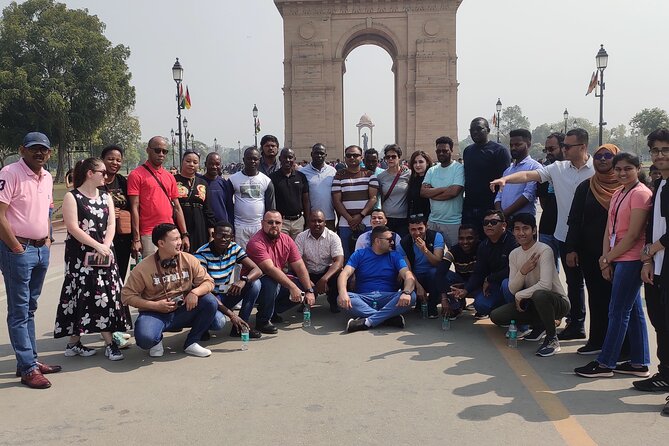
India Gate is a war memorial connected with the First World War, from 1914 to 1918. The monument records the names of soldiers who gave their lives, making this more than a quick photograph stop.
You have about 30 minutes here. That allows time to view the structure, read some of the inscriptions, and hear the guide explain its purpose. The memorial is also one of the clearest examples of how British-era public architecture remains part of Delhi’s daily visual identity.
I like the change of mood from government buildings to remembrance. Rashtrapati Bhavan and Parliament House represent administration. India Gate is about military service and loss. Taken together, the first three stops show different reasons the British built monumental spaces in the capital.
The stop may be busy, and the tour does not promise a long guided walk around every part of the memorial. Use the time well by asking your guide about the names and the memorial’s connection with the First World War.
Same starting point, a completely different day out:
- Old & New Delhi City Tour – Half or Full Day Options Available
★ 5.0 · 4,811 reviews - Same Day Taj Mahal, Agra Fort & Baby Taj Tour from Delhi by Car
★ 5.0 · 4,304 reviews - Taj Mahal Day Tour from Delhi by Superfast Train – TOP RATED TOUR
★ 5.0 · 4,166 reviews - Full Day Taj Mahal, Agra Fort & Baby Taj Tour from Delhi by Car
★ 5.0 · 3,647 reviews
Agrasen Ki Baoli, the tour’s best architectural change of pace
Agrasen Ki Baoli is a 14th-century water stepwell. It is one of the most distinctive stops because it takes you away from the broad, formal avenues of British Delhi and into an older form of Indian water architecture.
A stepwell was designed to let people reach water as its level changed. Here, the interest is not simply the stonework. The structure shows how water collection, public access, and architecture were linked long before the British-built capital took shape.
The scheduled visit is about 30 minutes. That is enough to look around and take in the unusual setting, though you may want longer if you enjoy architectural details. The tour description identifies this as a strong example of 14th-century design, and it is easy to see why it gives the day more depth.
Agrasen Ki Baoli can also be a useful test of the tour’s style. Ask questions rather than simply following the guide from one photo point to the next. A private guide has more room to explain how the stepwell differs from the government buildings you have just seen.
Hailey Road dhobi ghat and everyday work
Hailey Road brings you to a public laundry, or dhobi ghat, that dates from the British period. It was originally for British officers and is now used by citizens of Delhi.
This is one of the most grounded stops on the route. You can see clothes being cleaned by hand in an Indian laundry tradition, rather than only visiting monuments designed to impress officials or commemorate wars.
The planned visit lasts about 30 minutes, though the exact experience will depend on what work is taking place when you arrive. The stop is not presented as a museum. It is a look at a living public facility, so approach it with respect and follow your guide’s advice about where to stand and what may be photographed.
I value this stop because it gives the British period a human scale. A capital is not only its grand buildings. It also includes services, workers, and public spaces that continue to serve the city after the original rulers are gone.
Bengali Market for sweets, bakery items, and a local pause
Bengali Market is the food-oriented stop, with shops selling daily needs, traditional sweets, Delhi food, and bakery items. The visit is scheduled for about 45 minutes, making it one of the better places to slow down.
Lunch is not included, but that is not necessarily a problem here. You can ask your guide what is suitable and use the stop to buy sweets, snacks, or bakery goods. The information provided does not specify a fixed restaurant or meal, so budget separately for anything you eat.
The market also gives you a look at practical city life. Alongside the food shops, you may notice the vehicle parking system and the mix of everyday businesses. That may sound ordinary, but it is exactly what helps a short sightseeing tour feel connected to the city rather than sealed off from it.
Be aware that 45 minutes is enough for a taste, not a full food crawl. If you care most about eating, tell the guide early. If your priority is monuments, you may prefer to use the stop for one or two things rather than trying to sample everything.
Connaught Place, the 1923 shopping district
Connaught Place was built by the British in 1923 as a major shopping area. Its planned commercial design makes it a useful final urban contrast to the government district.
The schedule allows about one hour here, the longest single stop on the route. That gives you time to walk, browse, and see how a colonial-era commercial center functions as part of modern Delhi.
Connaught Place is not only about shopping. It is also about urban planning. The area was designed as a market district, while the earlier stops were tied to government and memorial use. Moving through these places shows how the British capital was divided into different zones.
The hour can pass quickly, especially if you stop for food or shopping. Since the tour is private, you may be able to tell your guide what interests you most. Do not expect a dedicated shopping budget or lunch to be included. Treat this as a chance to look around and choose your own purchases.
Pracheen Hanuman Mandir and living Hindu worship
The last listed stop is Pracheen Hanuman Mandir in Connaught Place, an old temple dedicated to Hanuman, the Hindu deity shown with a monkey face. The visit is scheduled for about 30 minutes.
This temple changes the tone again. After government buildings, a memorial, a stepwell, a laundry, a market, and a shopping district, you finish with a place of Hindu worship. It is a reminder that Delhi’s historic character is not only held in stone buildings. It is also kept alive through religious practice.
Your guide can explain the temple and help you understand what you are seeing. Remember that this is a religious site, not simply another attraction. Follow local instructions and behave quietly and respectfully.
The itinerary does not give detailed rules about clothing, shoes, photography, or entry procedures. Ask your guide at the temple rather than assuming. The half-hour allocation should let you see the site, but it is not intended as an extended religious visit.
What the $60 price includes and what it does not
At $60 per person, the value depends on how many people are in your private group and how much you value transport and guiding. You are paying for a four to five-hour private outing, an air-conditioned vehicle, bottled water, onboard WiFi, and a guide who can connect the sites.
For a small group, that can be a sensible way to cover central Delhi without arranging separate rides between eight stops. The private format also lets you ask for explanations and adjust your attention within the available time.
The price does not include lunch. It also does not promise a long interior visit at every monument. I would judge the value by the route and the guide rather than by the number of admission lines, since the main benefit is seeing several different parts of central Delhi in one organized half-day.
You should also allow for the possibility that traffic shortens the time at individual stops. The tour is advertised as four to five hours, while the listed stop durations add up to more than four hours before driving time. That means the schedule is a framework, not a guarantee that every stop receives its full printed duration.
Who should book this private Delhi outing
I would recommend it to a first-time Delhi visitor who wants an introduction to the British-era center without spending a full day on a single monument. It also suits you if you prefer a private car, direct access to a guide, and a mix of architecture, food, religion, and daily work.
It is a good fit for people who want context. The route has a clear progression from imperial government to independent India, from formal monuments to public laundry, and from planned shopping streets to an old Hindu temple.
You may want something else if you prefer slow museum visits, long meals, or extensive time at each site. Eight stops in four to five hours is ambitious. You will see variety, but you will need to accept short visits and movement between locations.
Pickup is offered, and confirmation is received at booking. Most people can participate, and only your group takes part. The experience requires good weather. If poor weather causes cancellation, you can choose another date or receive a full refund. You can cancel for a full refund up to 24 hours before the start time, but later cancellations and changes are not accepted.
Should you book it?
Book this tour if you want a well-organized first look at central Delhi and enjoy moving between major landmarks and ordinary city scenes. Agrasen Ki Baoli, the Hailey Road laundry, Bengali Market, and the Hanuman temple keep it from becoming a simple government-building circuit.
The strongest reason to choose it is the combination of private transport and a broad route. Ask whether Raj is available if you want the guide specifically associated with the strongest feedback, and make clear whether food, architecture, religion, or history matters most to you.
Skip it if you want a slow, specialist visit to one or two sites. For everyone else, $60 per person can be fair value, especially for a small private group that wants a compact, varied introduction to British Delhi.
FAQ
How long does the private British Delhi tour last?
The experience lasts approximately four to five hours.
Where does the tour take place?
The tour takes place in New Delhi, India, and visits sites in and around central Delhi.
Is hotel or other pickup available?
Pickup is offered, though the supplied information does not specify the exact pickup locations.
Is the tour private?
Yes. Only your group participates in the private tour.
Is transportation included?
Yes. An air-conditioned vehicle is included.
Is bottled water provided?
Yes. Two branded mineral-water bottles are provided for each person.
Is WiFi available during the tour?
Yes. WiFi is included onboard the vehicle.
Is lunch included?
No. Lunch is not included. Bengali Market is one place where you can find traditional food, sweets, and bakery items.
Which monuments are included?
The route includes Rashtrapati Bhavan, Parliament House, India Gate, Agrasen Ki Baoli, Hailey Road dhobi ghat, Bengali Market, Connaught Place, and Pracheen Hanuman Mandir.
Can I cancel for a full refund?
Yes. You can cancel at least 24 hours before the experience start time for a full refund. Cancellations or changes made less than 24 hours before the start time are not accepted. If poor weather causes cancellation, you can choose another date or receive a full refund.
Newly reviewed around New Delhi
- Private Customized Tour Of Old/New Delhi Spiritual Sites★ 5.0 · 5 reviews
- Yoga and Meditation Classes in Gurgaon★ 4.5 · 8 reviews
- Yoga class in Delhi★ 5.0 · 29 reviews
- Old Town Delhi Walking Tour (2 Hours Guided Tour with Local)★ 4.5 · 22 reviews
- 5 Days Golden Triangle Tour with Ranthambore(Delhi Agra Jaipur Ranthambore Tour)★ 5.0 · 3 reviews
- Wonderful Old & New Delhi sightseeing tour★ 5.0 · 3 reviews
- Hidden Gems of Old Delhi – Walk★ 5.0 · 8 reviews
- Delhi Zoo White Tigers & lions with Old Fort Visit★ 4.5 · 5 reviews
Private, compared.


All Inclusive Private Taj Mahal Luxury Tour from Delhi by Car
Read our review →
Old & New Delhi Private Tour – Half or Full Day (Rated Excellent)
Read our review →
Taj Mahal and Agra Private Car Tour from Delhi with 5* Lunch
Read our review →
Private Taj Mahal and Agra Tour by Express Train
Read our review →
Private Sunrise Taj Mahal Trip from Delhi all Inclusive
Read our review →