Reviewed · FOOD
Temple Tour-where you Eat, Learn how to Pray and Love.
Delhi’s most memorable temple experience may be the one that takes you beyond sightseeing. This four to five-hour tour moves from Sikh gurdwaras to Hindu and Jain temples, with a community kitchen meal and a Jain bird hospital along the way. You do not just look at sacred places. You learn how people pray, serve food, care for animals, and remember difficult history.
I like the small group, capped at eight people, and I like the mix of places that can be difficult to connect on your own. The free community kitchen meal and the bird hospital are especially unusual touches. The main caution is practical: booking reliability has been mixed, with one serious report of an unanswered booking and a guide who did not arrive.
Key points at a glance
- A rare three-faith itinerary: Visit Sikh, Hindu, and Jain religious sites in one half-day.
- A meal with a purpose: Sit in a Sikh community kitchen and learn how volunteer service works.
- Old Delhi from street to rooftop: Walk through Khari Baoli spice market and see the area from above.
- A Jain bird hospital: See an unusual place devoted to helping injured birds and learn why it exists.
- Personal guidance: Rahul leads the visit, explains customs, and can take your temple photos when selfies are not allowed.
- Good value for a small group: At $55 per person, the price includes the guide, tuk-tuk transport within the route, snacks, and bottled water.
Why this Delhi tour feels different
Many temple visits give you a quick look, a few photos, and little sense of what you are seeing. This one is built around explanation and participation. You can pray at the Hindu temple if you wish, sit for a communal meal, ask questions about Sikhism and Jainism, and hear why each site matters.
The route also connects religion with the life of Old Delhi. You begin in polished Connaught Place, then move into the spice trade around Khari Baoli and the lanes near the Red Fort area. The contrast is part of the experience. One moment you are discussing Delhi’s colonial-era commercial center, and soon after you are surrounded by temple flowers, spice aromas, prayer, and volunteer work.
This tour suits an open-minded visitor who wants context rather than a checklist. You do not need to be religious. You do need to be comfortable entering places of worship respectfully and listening to beliefs that may differ from your own.
More food tours in New Delhi:
- The Great Indian Food Tour: Old Delhi Food and Heritage Walk
★ 5.0 · 1,698 reviews - Old Delhi Food, Heritage&Cultural Walk with Rickshaw ride to Masterji Kee Haveli
★ 5.0 · 742 reviews - Old Delhi Street Food Tour
★ 5.0 · 497 reviews
Starting at Connaught Place, then switching to a tuk-tuk
The meeting point is Connaught Place, at Gate 7. The tour begins with an introduction to the area, including its history and architecture. It is also a useful place for photographs before the route heads toward Old Delhi.
After a five to ten-minute walk, you continue by tuk-tuk for about 20 minutes. The ride gives the tour a local feel and saves you from covering the whole route on foot. It also means you should expect a little road noise, traffic, and movement rather than a quiet sightseeing bus.
The tour ends back at Connaught Place, so you are not left in an unfamiliar part of Delhi. The mobile ticket is useful for a quick meeting-point check, and the route is near public transportation.
Khari Baoli, where the tour smells like India
Khari Baoli is one of the strongest parts of the route. You walk through Old Delhi’s famous spice market, then visit a well-known rooftop for views and photographs. The stop lasts about 40 minutes, enough time to take in the setting without turning the tour into a long market visit.
This is a good place to pay attention to your senses. The stop is not only about seeing sacks and shopfronts. The scent of spices gives you a direct link to the trade that has helped shape Old Delhi’s commercial life.
The rooftop adds another angle. From above, you can better understand how tightly packed this part of the city is and capture photographs that are difficult to get from street level. Stay close to the guide, since market lanes can be busy and easy to lose track of in a small group.
Gurudwara Sis Ganj Sahib and the meaning of Sikh welcome
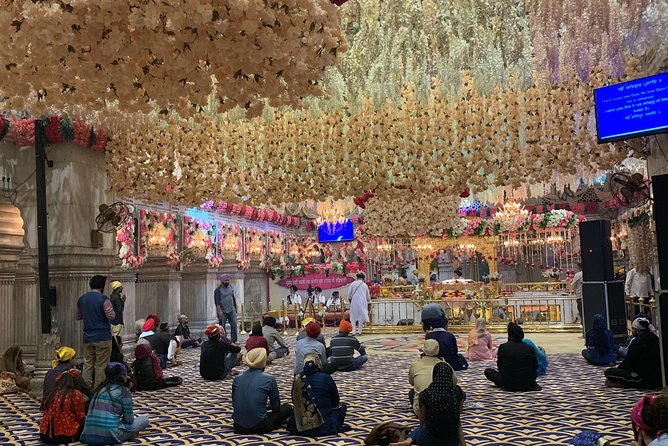
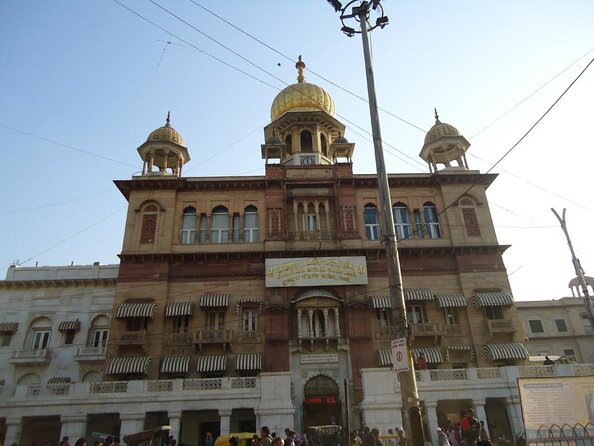
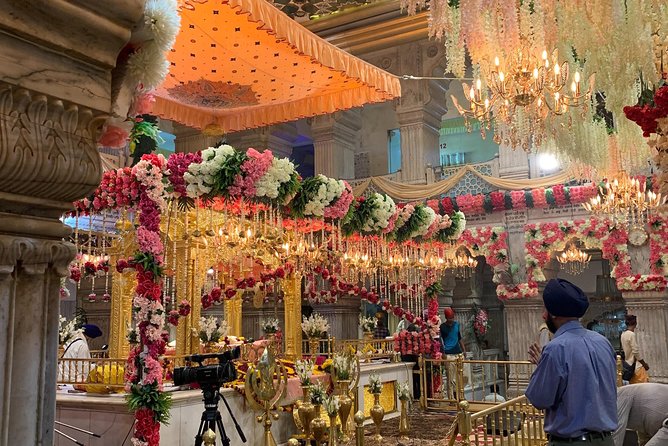
The first main religious visit is Gurudwara Sis Ganj Sahib, a Sikh place of worship. You learn how Sikhism began, hear about the site’s past, and enter the temple itself.
The setting is described as colorful and decorated with flowers. More important, the guide explains what you are seeing instead of leaving you to guess your way through an unfamiliar religious space. If you have never visited a gurdwara, this help matters. Customs, prayer, and the role of service can be hard to understand from a doorway.
The visit lasts about 25 minutes. That is enough for an introduction, though not enough for an extended study of Sikh practice. Come ready to follow the guide’s instructions and behave as you would in any active place of worship.
Same starting point, a completely different day out:
- Old & New Delhi City Tour – Half or Full Day Options Available
★ 5.0 · 4,811 reviews - Same Day Taj Mahal, Agra Fort & Baby Taj Tour from Delhi by Car
★ 5.0 · 4,304 reviews - Taj Mahal Day Tour from Delhi by Superfast Train – TOP RATED TOUR
★ 5.0 · 4,166 reviews - Full Day Taj Mahal, Agra Fort & Baby Taj Tour from Delhi by Car
★ 5.0 · 3,647 reviews
The square where Sikh history turns painful
A short historical stop follows near Sis Ganj Sahib. Here, Rahul explains the execution of Guru Tegh Bahadur, the ninth Sikh Guru, who was beheaded on November 11, 1675, on the order of Aurangzeb.
The story does not stop with the execution. One of Guru Tegh Bahadur’s disciples, Lakhi Shah Vanjara, took his body away under cover of darkness before it could be publicly displayed. He then burned his house to cremate the Guru. The place associated with that cremation is marked by Gurudwara Rakab Ganj Sahib.
This is a brief, ten-minute explanation, but it gives the next stop more meaning. You are not just visiting a religious building. You are standing close to a location tied to sacrifice, persecution, loyalty, and remembrance.
The subject is serious, and the guide’s direct explanation may feel intense. That is a strength for visitors who want historical substance, but it may be uncomfortable if you are seeking only light sightseeing.
Gurudwara Rakab Ganj and a meal served by volunteers
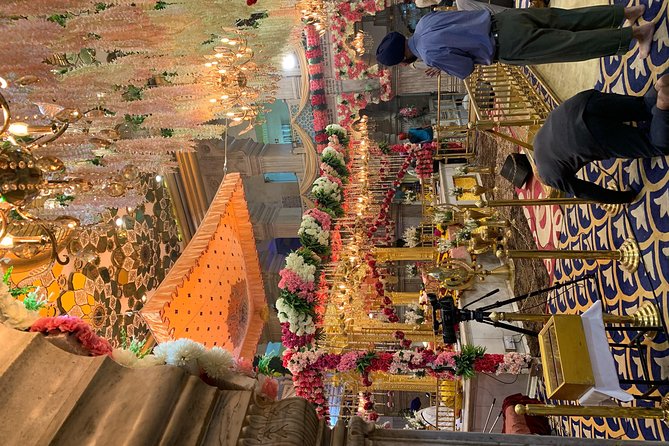
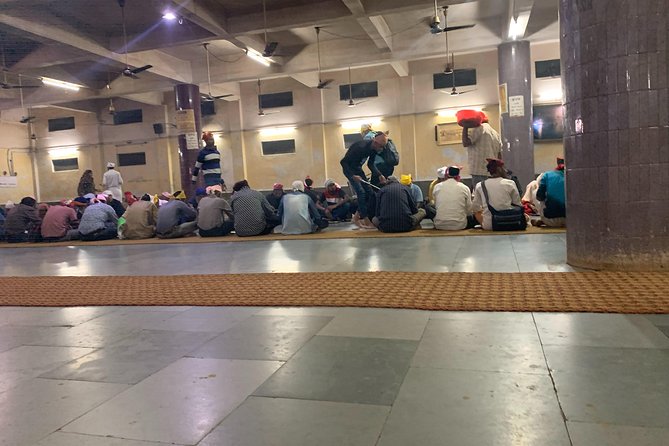
At Gurudwara Rakab Ganj, the tour visits the community kitchen. You sit down for a free meal, see the kitchen, meet people involved in the work, and ask Rahul questions about Sikh beliefs and practice.
This is one of the most useful parts of the experience because it turns an idea into something you can see. Sikh community kitchens are connected with service and shared meals. Instead of hearing only about generosity, you watch people prepare and serve food, then take part in the meal yourself.
The stop lasts about 40 minutes. That gives you time to eat and observe, though the schedule is still moving. Snacks and bottled water are also provided during the tour, but the community meal is the more memorable food experience.
Approach the kitchen with humility. You are entering a working religious and volunteer space, not a staged food attraction. Listen to the instructions, follow the local custom, and avoid treating the meal as merely a photo opportunity.
Gauri Shankar Temple and the option to pray
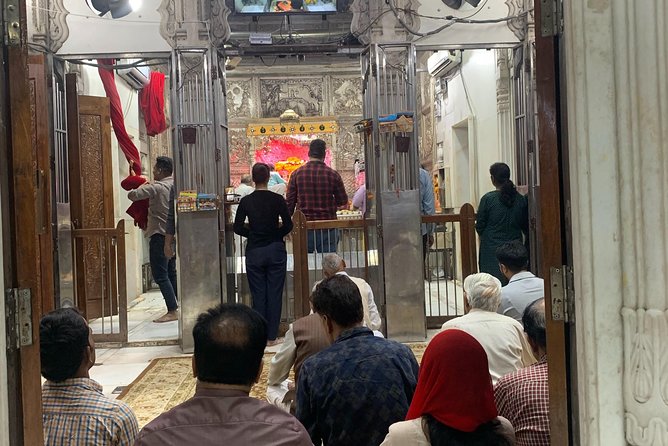
The route then shifts to Hindu tradition at Gauri Shankar Temple, dedicated to Lord Shiva and his wife. The visit lasts about 30 minutes, and Rahul explains Hindu beliefs while you move through the temple.
You may pray, chant, or simply observe. That freedom makes the stop accessible to people with different reasons for visiting. You can participate if it feels appropriate, or remain quiet and respectful while learning.
Photography is allowed according to the tour information, but selfies are not permitted in the temples. Rahul can take a photograph of you instead. This small rule is worth knowing before you arrive, since it keeps the focus on the sacred setting and avoids an awkward moment.
The temple visit is best for someone willing to slow down. Hindu worship can include several forms of prayer and ritual, and a short guided explanation will not cover everything. Still, the guide gives you a starting point that is far more useful than walking in alone.
Sri Digambar Jain Lal Mandir and a quieter mood

The final temple is Sri Digambar Jain Lal Mandir. Here, you learn what Jainism is, when it began, and how its ideas differ from the traditions encountered earlier.
The stop lasts about 30 minutes and is described as the calmest part of the route. After the noise and movement of Old Delhi, that quieter setting can feel like a welcome change. You have time to ask questions and think about the emphasis Jainism places on respect for every living creature.
This part of the tour adds real balance. The experience is not only about better-known religious traditions. It gives Jain practice its own place and avoids presenting India as one single spiritual culture.
The Jain bird hospital, the tour’s most unusual stop
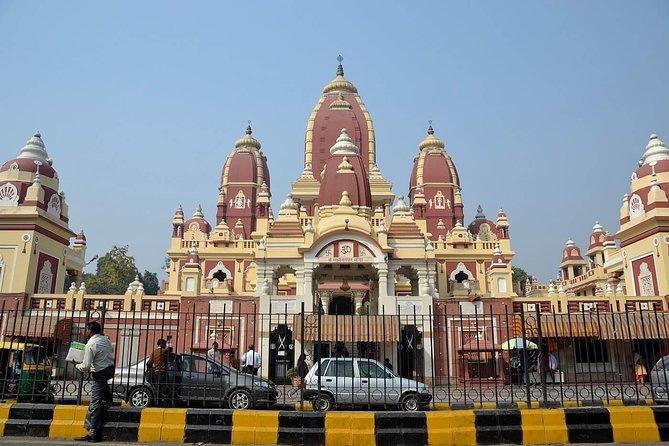
Inside the Jain temple complex is a bird hospital. It is one of the most distinctive features of the tour, and the visit lasts about 30 minutes.
The hospital reflects the Jain belief that every living creature matters. Rahul explains how and why the facility began, and you learn how that belief shapes an actual place of care. It is an unusual stop that many independent sightseeing routes would likely miss.
The bird hospital is also a good example of why context matters. Without an explanation, you might see a hospital for birds as a curiosity. With the religious background, it becomes a practical expression of Jain ethics.
Expect this visit to be less polished than a conventional attraction. Its value comes from the idea and the work taking place there, not from grand displays. If you care about animal welfare or want to understand Jain principles through a real institution, give this stop your full attention.
How the $55 price works out
At $55 per person, this is not the cheapest way to see Delhi’s temples. Yet the price covers a four to five-hour guided route, a small group of no more than eight people, tuk-tuk transport during the itinerary, snacks, bottled water, and the chance to visit several sites that would be difficult to link independently.
The guide is the main value. Rahul provides the explanations, handles the transitions between different places of worship, and answers questions about Sikh, Hindu, and Jain practice. Without that help, you could enter some of these sites but miss much of their meaning.
The meal at the community kitchen and the bird hospital also give the tour a different character from a standard temple circuit. You are paying for access to a connected experience, not simply admission tickets. The individual sites do not charge an entry fee, so the price makes sense only if you value the guide, transport, small group, and interpretation.
One important reservation concerns reliability. One serious account describes an unanswered email, an unreachable phone, and a guide who never arrived. Other feedback describes Rahul, sometimes written as Raul, as exceptionally kind, safe, and helpful, with strong praise for the temples and the amount learned. Because those experiences conflict, confirm your booking details and meeting arrangements before the day of the tour.
Who should book this experience
I would choose this tour if you want to understand how religion appears in daily life, not just photograph temple doors. It is particularly well suited to curious visitors who enjoy asking questions and are happy to follow local customs.
You will likely get the most from it if you:
- Want to see Sikh, Hindu, and Jain sites in one outing
- Prefer a small group to a large sightseeing party
- Like local food and volunteer-run community spaces
- Want a guide to explain prayer, history, and etiquette
- Are interested in the connection between religion and animal care
- Can handle walking, a tuk-tuk ride, and a fairly full half-day
It may be less suitable if you want a relaxed, private visit with lots of free time at each temple. The schedule includes many stops, and the historical section at Sis Ganj Sahib is emotionally heavy. It is also not the right choice if you want to take selfies inside temples or treat religious sites as casual photo stops.
The tour is listed as suitable for most people and is near public transportation. Specific accessibility details are not provided, so ask the operator if you have mobility concerns.
Booking, weather, and cancellation details
Confirmation is provided when you book, and you can cancel for a full refund up to 24 hours before the start time. Cancellations or changes made within 24 hours are not refunded or accepted.
The tour requires good weather and a minimum number of participants. If poor weather or low enrollment cancels the outing, you are offered another date or experience, or a full refund.
Because of the conflicting booking experiences, save the provider’s contact details and check that the meeting time at Connaught Place, Gate 7, is clear. The activity returns to the same meeting point by tuk-tuk.
Should you book this temple tour?
Book it if you want a thoughtful introduction to Delhi’s religious life, with real contact points such as a community kitchen and a Jain bird hospital. The three-faith route, small group, and guide Rahul’s personal explanations make it more useful than simply visiting temples on your own.
The price is fair for the time, transport, food-related experiences, and instruction, but it is not a bargain-basement outing. Go in with respect, expect a busy half-day, and confirm the booking before you set out. If you do that, this is a strong choice for an open-minded visitor who wants to learn how people pray, serve, remember, and care for living things in Delhi.
FAQ
How long does the temple tour last?
The tour lasts approximately four to five hours.
Where does the tour start and end?
It starts at Connaught Place in New Delhi, at Gate 7, and ends back at the same meeting point.
How many people can join the tour?
The group has a maximum of eight participants.
Which religions are included?
The tour visits Sikh gurdwaras, a Hindu temple, and a Jain temple.
Is food provided?
Snacks and bottled water are provided, and you also sit for a free meal in the Sikh community kitchen at Gurudwara Rakab Ganj.
Can I take selfies inside the temples?
No. Selfies are not allowed inside the temples, but Rahul can take a photograph of you.
What is the cancellation policy?
You can cancel at least 24 hours before the start time for a full refund. Cancellations or changes made less than 24 hours before the experience are not accepted and are not refunded.
Newly reviewed around New Delhi
- Private Customized Tour Of Old/New Delhi Spiritual Sites★ 5.0 · 5 reviews
- Yoga and Meditation Classes in Gurgaon★ 4.5 · 8 reviews
- Yoga class in Delhi★ 5.0 · 29 reviews
- Old Town Delhi Walking Tour (2 Hours Guided Tour with Local)★ 4.5 · 22 reviews
- 5 Days Golden Triangle Tour with Ranthambore(Delhi Agra Jaipur Ranthambore Tour)★ 5.0 · 3 reviews
- Wonderful Old & New Delhi sightseeing tour★ 5.0 · 3 reviews
- Hidden Gems of Old Delhi – Walk★ 5.0 · 8 reviews
- Delhi Zoo White Tigers & lions with Old Fort Visit★ 4.5 · 5 reviews
Food, compared.

The Great Indian Food Tour: Old Delhi Food and Heritage Walk
Read our review →
Old Delhi Food, Heritage&Cultural Walk with Rickshaw ride to Masterji Kee Haveli
Read our review →

Delhi Food Walk: Rickshaw Ride, Street Eats & Market Tour
Read our review →
Old Delhi Street Food Tour – Explore Spices in Chandni Chowk
Read our review →
Old Delhi Food-Spice Market-Temples Tour Soon Featured on NETFLIX
Read our review →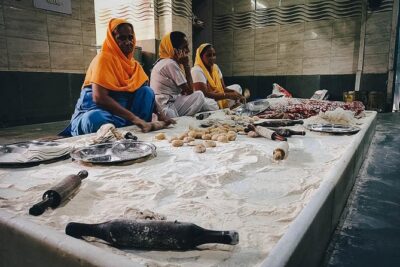
Chandni Chowk Delhi Food Tour with 15+ Tastings
Read our review →