
Reviewed · NEW DELHI
Half Day Religious Enlightenment
Delhi’s religious life comes into focus on this compact tour, which links the Lotus Temple, ISKCON Temple, Akshardham, and Bangla Sahib in about four to five hours. You get a quick look at several faiths without spending a full day in traffic or arranging separate rides.
I like the private air-conditioned vehicle and the chance to ask questions as you go. I also like the mix of quiet prayer spaces, grand temple architecture, and the Sikh community kitchen. The main drawback is the brisk pace: with only 30 minutes at most stops, you will get an introduction, not a detailed study.
- Four very different religious sites: Bahá’í, Hindu, Vaishnava, and Sikh traditions appear in one short outing.
- Akshardham gets the longest visit: Plan on about an hour for Delhi’s huge Hindu temple complex.
- Bangla Sahib includes community service: The kitchen offers a look at Sikh hospitality in practice.
- Private transport keeps the route practical: An air-conditioned vehicle saves time between widely separated sites.
- A guide adds cultural context: Ask questions about worship, symbols, and daily practice rather than treating the temples as photo stops.
- The pace favors first impressions: This suits a short Delhi stay, but not visitors seeking long visits at each temple.
Four faith traditions in one Delhi morning
This tour works because it treats Delhi’s religious buildings as living places, not just monuments. You move from the quiet, modern form of the Lotus Temple to the devotional energy of ISKCON, the scale of Akshardham, and the open welcome of Bangla Sahib.
The route covers several traditions, but it does not pretend to offer a full course in Indian religion. Your guide’s role matters here. An English-speaking local guide can explain what you are seeing, answer direct questions, and help you behave respectfully in places where worship still takes place.
The tour is private, so only your group participates. That is useful if you want to stop for clarification, adjust the pace slightly, or focus on a particular faith. It also means the quality of the day depends in part on the guide you receive. Deepak is named in other Delhi tour feedback as a warm, clear guide who answers questions without showing off, but a particular guide is not guaranteed for this experience.
Starting at the Lotus Temple
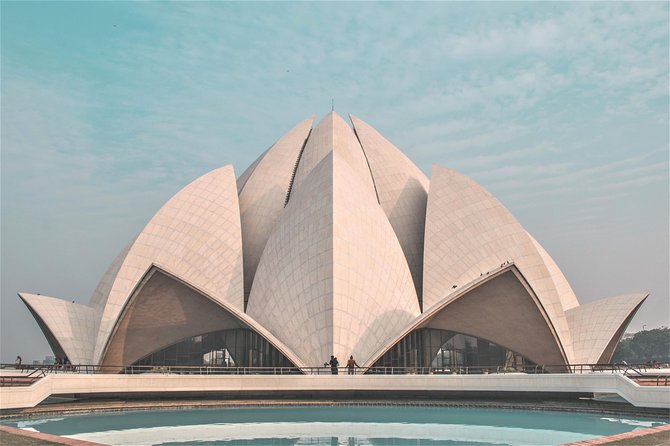
The Lotus Temple is the first stop, with about 30 minutes set aside for the visit. Its white, flower-like shape is one of Delhi’s most recognizable sights, but the important point is the idea behind the building. The Bahá’í faith welcomes people of all religions and places emphasis on the unity of humanity.
Your guide can help connect the architecture with that message. Inside, the atmosphere is generally quiet, and the building is intended for prayer and reflection rather than a service led by one particular religious group. This makes it a gentle opening to the morning.
Thirty minutes is enough to see the building and understand its purpose, but you should not expect a long visit. Depending on the day, time may be used for walking, entry arrangements, and quiet time inside. Dress with respect and keep your voice low.
I like beginning here because the temple offers a calm contrast to Delhi’s roads. It also gives you a useful question to carry through the rest of the tour: how does each religious community express its beliefs through space, ritual, and service?
Other New Delhi trips people book alongside this one:
- Old & New Delhi City Tour – Half or Full Day Options Available
★ 5.0 · 4,811 reviews - Same Day Taj Mahal, Agra Fort & Baby Taj Tour from Delhi by Car
★ 5.0 · 4,304 reviews - Taj Mahal Day Tour from Delhi by Superfast Train – TOP RATED TOUR
★ 5.0 · 4,166 reviews
ISKCON Temple and the story of Krishna
The second stop is Delhi’s ISKCON Temple, also known as a Hare Krishna temple. The visit lasts about 30 minutes, so the guide’s explanation will be more important than a long period of independent wandering.
ISKCON centers worship Krishna, a major Hindu deity, and the organization grew from roots in New York City before establishing temples around the world. At this stop, you can ask your guide about Krishna’s place in Hindu belief and about the devotional tradition followed by the society.
The temple gives the tour a different tone from the Lotus Temple. Instead of the Lotus Temple’s broad invitation to people of all faiths, ISKCON presents a specific Hindu path centered on devotion to Krishna. That contrast is one of the strongest features of the route.
Again, the timing is tight. If you want detailed information about Hindu theology, iconography, or the history of the organization, tell your guide early. A short stop is best treated as an introduction, with enough time to notice the setting and ask a few focused questions.
Akshardham’s scale and spectacle
Akshardham receives about one hour, the longest scheduled visit. That extra time makes sense. This is a large Hindu temple complex, known for its grand design and its place among the world’s largest Hindu temples.
The first thing you notice is scale. Akshardham is not a small neighborhood shrine that you can understand in ten minutes. The carved stonework, broad grounds, and formal layout require time to take in. Your guide can explain the religious meaning of the complex and help you separate what is traditional from what is part of the modern visitor presentation.
The hour still passes quickly. The schedule allows you to walk around and see the main areas, but it is not designed for a slow, detailed architectural inspection. You may find that the practical parts of visiting, including movement through the complex, take a meaningful share of the time.
Akshardham is also the stop most likely to shape your sense of the tour’s limits. You see an impressive Hindu center, but you will not have time to explore every corner. If this temple is your main reason for booking, ask the operator how much time is actually available there on your chosen date.
Bangla Sahib and Sikh service
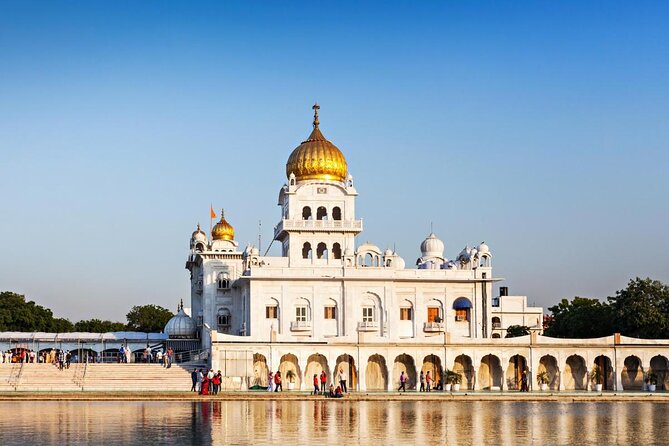
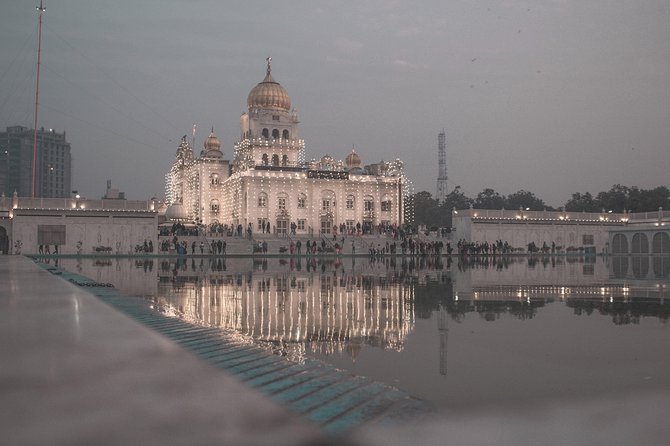
The final religious stop is Gurudwara Bangla Sahib, described as Delhi’s largest Sikh temple. About 30 minutes are planned here, and the most valuable part may be the chance to see the community kitchen.
A Sikh gurdwara is not simply a place to admire. It is also a place of welcome, prayer, and service. The kitchen, often called a langar, reflects the Sikh principle that people should be fed without regard to status or background. Seeing this side of the site helps turn an abstract lesson about Sikhism into something practical.
Your guide can explain basic customs and help you approach the gurdwara respectfully. You should expect to follow local rules about conduct and dress. The short visit may allow only a brief look at the kitchen and the main setting, so ask questions while you are there.
I consider Bangla Sahib an especially useful ending because it brings the tour back to ordinary people and shared responsibility. After the formal architecture of the earlier stops, the focus on food and service shows how religious belief can shape daily action.
Same starting point, a completely different day out:
- Full Day Taj Mahal, Agra Fort & Baby Taj Tour from Delhi by Car
★ 5.0 · 3,647 reviews - From Delhi: Taj Mahal & Agra Private Day Trip with Transfers
★ 4.9 · 3,181 reviews - Taj Mahal Tour from Delhi by Express Train (Viator Award Winner)
★ 5.0 · 2,849 reviews - All Inclusive Private Taj Mahal Luxury Tour from Delhi by Car
★ 5.0 · 2,564 reviews
What the private vehicle changes
Delhi’s temples are not gathered in one compact old quarter. Moving between them can take time, especially when road conditions are slow. The private air-conditioned vehicle is therefore more than a comfort feature. It makes a four to five hour route with four stops possible.
Hotel pickup and drop-off are included for Delhi/NCR, according to the tour details. At the same time, the listed meeting point is United Coffee House at E-15, Block E, Connaught Place, with the activity ending back at the meeting point. That creates a detail you should confirm before booking: ask where your pickup and return will actually occur.
Because the vehicle is private, you do not share the day with a large group. That can make short stops feel less rushed, since you are not waiting for a bus full of people. It also gives you a better chance to discuss topics that interest you, from Sikh service to Hindu worship or Bahá’í principles.
The air conditioning matters in Delhi, particularly if you are visiting during hot weather. Still, the tour is not a long time spent inside a car. You will walk at each religious site, so comfortable footwear and modest clothing are sensible choices.
Is $60 a fair price?
At $60 per person, the cost includes hotel pickup and drop-off, private air-conditioned transport, admission tickets, and a private English-speaking guide. Meals, drinks, and gratuities are extra.
For one person, the price is not the cheapest way to see temples in Delhi. You are paying for convenience, a driver, a guide, and a route that would take planning to arrange independently. The value improves for couples, families, or small groups that can share the private vehicle and use any available group discount.
The guide is the part that can make or break the price. A good explanation turns four quick visits into a connected lesson about faith in Delhi. Without much interpretation, the tour risks becoming a sequence of buildings viewed through a car window.
Gratuities are recommended, though the amount is not specified. Carry money for drinks or food as well, since those are not included. The experience has a five-star rating based on three reviews, but that is a small sample, so I would treat it as encouraging rather than conclusive.
Who will get the most from this tour?
This experience suits you if you have limited time in Delhi and want a guided introduction to several religious traditions. It is also useful if you prefer a private outing rather than joining a large scheduled group.
Families may like the variety. Children who lose interest in one temple may find the next stop different enough to hold their attention. Couples and first-time visitors can also benefit from the straightforward route and the ability to ask questions in a private setting.
You should think twice if you want long periods for photography, meditation, or detailed study. Three stops allow only 30 minutes, and even Akshardham receives about an hour. The experience is best for breadth, not depth.
It is also a good choice if you want more than architecture. The Lotus Temple introduces a faith built around human unity, ISKCON presents devotion to Krishna, Akshardham shows Hindu religious design on a grand scale, and Bangla Sahib connects Sikh belief with feeding and service.
Practical advice for a respectful visit
Wear clothing that is comfortable but respectful at religious sites. Your guide can explain any specific rules at each stop, but modest dress and a quiet manner are sensible throughout the morning.
Use the short drives to ask questions. You might ask how worship differs at the four sites, what visitors should notice in the buildings, or how the community kitchen works. These questions will help you get more from the tour than simply taking photographs.
Keep your schedule flexible. The advertised duration is approximately four to five hours, and Delhi traffic can affect the timing. If you have a flight, train, or fixed appointment afterward, leave a generous buffer.
The tour offers free cancellation up to 24 hours before the start time. Cancellations or changes made less than 24 hours before departure are not accepted for a refund, and the cut-off follows local time.
Should you book Half Day Religious Enlightenment?
Book it if you want a practical, private introduction to several Delhi faiths in one morning. The strongest reasons are the four contrasting religious sites, the included vehicle and admissions, and the chance to speak with a local English-speaking guide.
Skip it if you want a slow visit at each temple or if Akshardham alone deserves most of your day. Before paying, confirm the pickup point, ask how much time is expected at each stop, and check whether Deepak is available if his calm, question-friendly guiding style is important to you.
For a first Delhi visit, a short stay, or a traveler who values context over a simple sightseeing drive, this is a useful way to begin understanding the city’s religious life.
FAQ
How long does the religious tour last?
The experience lasts approximately four to five hours.
What places are included?
The route includes the Lotus Temple, ISKCON Temple Delhi, Swaminarayan Akshardham, and Gurudwara Bangla Sahib.
Is hotel pickup available?
Yes. Hotel pickup and drop-off are included for Delhi/NCR, though the listed meeting information also gives United Coffee House in Connaught Place as the start and end point. Confirm the exact arrangement before booking.
What type of transportation is provided?
You travel in a private air-conditioned vehicle.
Is the tour private?
Yes. Only your group participates in the activity.
Is a guide included?
Yes. A private English-speaking local guide is included.
Are admission tickets included?
Yes. Admission tickets for the listed stops are included.
Are meals and drinks included?
No. Meals and drinks are not included in the price.
Can I cancel for a full refund?
Yes, if you cancel at least 24 hours before the experience start time. Cancellations or changes made less than 24 hours before the start time are not accepted for a refund.
Newly reviewed around New Delhi
- Private Customized Tour Of Old/New Delhi Spiritual Sites★ 5.0 · 5 reviews
- Yoga and Meditation Classes in Gurgaon★ 4.5 · 8 reviews
- Yoga class in Delhi★ 5.0 · 29 reviews
- Wonderful Old & New Delhi sightseeing tour★ 5.0 · 3 reviews
- Old Town Delhi Walking Tour (2 Hours Guided Tour with Local)★ 4.5 · 22 reviews
- 5 Days Golden Triangle Tour with Ranthambore(Delhi Agra Jaipur Ranthambore Tour)★ 5.0 · 3 reviews
- Hidden Gems of Old Delhi – Walk★ 5.0 · 8 reviews
- Delhi Zoo White Tigers & lions with Old Fort Visit★ 4.5 · 5 reviews