
Reviewed · DELHI WALKING TOURS
3-Hour Mehrauli Archaeological Park Ruins Walking Tour Delhi
Delhi’s Mehrauli Archaeological Park packs several centuries of Delhi into a quiet walk through ruins, tombs, woodland, and old waterworks. The most intriguing part is the contrast: you move from a finely decorated tomb and mosque to a ruined royal grave, a Victorian-era folly, and a stepwell linked with ghost stories.
I like the small maximum group of 15, which gives a guide room to explain details and answer questions. I also like the way the tour connects architecture with human stories. Guide Jai Singh, who has led this walk, is praised for detailed explanations and for discussing competing versions of the past rather than forcing one neat answer.
The main drawback is the narrow focus. You get about two to three hours on foot, with no meal or transport included, and the schedule may feel short if you want to linger at every ruin or explore Delhi’s wider history.
Key points to know before you book
- A compact tour of Delhi’s historical layers: See monuments from different periods in one archaeological park rather than spending the day crossing the city.
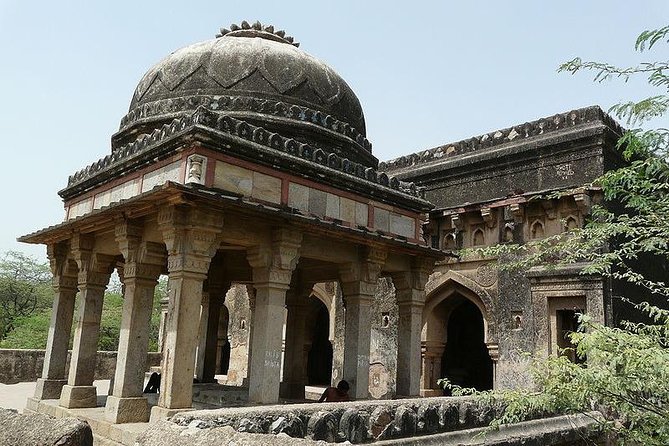
- Three main stops with extra sights along the way: Jamali Kamali, Balban’s Tomb and Metcalf Canopy, and Rajon Ki Baoli form the core route.
- A guide-led experience: Jai Singh has led the walk and is noted for detailed explanations, personal conversation, and open discussion of historical interpretations.
- Morning timing helps: The walk begins around 8:00 to 9:00 a.m., useful for a cooler, quieter visit.
- Haunted-place stories are part of the appeal: Rajon Ki Baoli and other ruins are associated with Delhi ghost lore, though the tour also offers architecture, birds, and history.
- Good value for a short specialist walk: At $28.47 per person, the price mainly pays for the local guide and focused context, not transport, food, or a full-day sightseeing program.
Why Mehrauli is a smart place to study Delhi
Delhi can feel like several cities laid on top of one another. Forts, mosques, tombs, colonial buildings, modern roads, and village lanes all occupy the same broad urban area. Mehrauli Archaeological Park gives you a manageable way to see that layering without spending the day in traffic.
The park contains monuments and ruins from different eras, many surrounded by trees and open ground. That setting matters. Instead of seeing each monument as an isolated stop beside a busy road, you can understand how the old structures relate to one another within the area.
I would not book this as a substitute for Delhi’s major sights. It is not a grand palace tour or a full survey of the city. Its value comes from the smaller scale. A guide can point out the marks, chambers, building styles, and local stories that are easy to miss when you walk alone.
The morning start is practical. The exact beginning is scheduled around 8:00 to 9:00 a.m., and the walk lasts roughly two to three hours. That leaves much of the day open for Qutub Minar, lunch, museums, or another part of Delhi.
More New Delhi monument and fort tours:
- Delhi Hidden Gems: Mehrauli, Lodhi Art & Sunder Nursery
★ 5.0 · 108 reviews - Red Fort Delhi Entry tickets with Licensed Tour Guide
★ 4.5 · 78 reviews - 3.5-Hours South Delhi Private Bike Tour with Lodi Art District
★ 5.0 · 37 reviews
Starting near Qutub Minar and Ladha Sarai Village
The meeting point is at Qutub Minar, at Aam Bagh in Ladha Sarai Village, Mehrauli, New Delhi. Public transportation is nearby, but transport to and from the meeting point is not included. You should plan that part yourself and allow enough time to arrive before the morning start.
The walk begins with a personal guide giving you an introduction to the history and geography of Mehrauli. This opening is more useful than it may sound. The park can seem like a collection of disconnected ruins if you do not first understand how the area fits into Delhi’s past.
A guide-led introduction also helps you set expectations. You are not simply walking from one famous monument to another. You are looking at fragments: tombs without their original surroundings, walls that have lost their upper sections, and water structures whose original purpose may not be obvious at first glance.
With a maximum of 15 people, the group should remain small enough for questions. The experience could feel different if the full group joins, but it is still more personal than a large coach excursion. If your guide is Jai Singh, expect a guide who has been praised for detailed historical explanations and an easy willingness to discuss different interpretations.
Jamali Kamali: poetry, faith, and decoration
The first listed stop is the Jamali Kamali Tomb and Mosque, with about 20 minutes set aside. This is a strong opening because it introduces both the religious and artistic side of the park.
The site is associated with Jamali, a poet and court figure, and Kamali, whose identity has long added to the mystery of the place. The tomb and mosque give the guide a chance to explain how religious buildings, burial places, and courtly culture overlapped in medieval Delhi.
You should pay attention to the decoration and the relationship between the mosque and tomb rather than rushing straight to a photograph. The guide’s explanations are especially valuable here because architectural details can be difficult to interpret without context.
The 20-minute stop is enough for an introduction, but not for a slow study of every feature. If you enjoy inscriptions, design, or architectural details, you may wish the schedule allowed more time. Still, the short visit keeps the walk moving and gives you room to see several different types of monument in one outing.
Jamali Kamali is also tied to local ghost stories. Those stories are part of the area’s reputation, but you should treat them as folklore rather than the main reason to visit. The stronger reason is the combination of poetry, worship, burial, and architecture in one compact site.
Balban’s Tomb and the view from Metcalf Canopy
The second section includes the Tomb of Balban and Metcalf Canopy, with roughly 20 minutes allocated. The itinerary description gives particular attention to the canopy, built in the 1850s by Charles Metcalfe as a folly.
A folly is a structure made mainly for appearance and amusement rather than for a practical purpose. Metcalf Canopy was designed to look old and to be viewed as part of a picturesque setting. That makes it an excellent counterpoint to the older ruins nearby.
Here, Delhi’s story shifts again. You are no longer looking only at medieval remains. You are also seeing how later British-era figures viewed and reshaped old monuments. The canopy reflects a period when ruins were treated as scenic objects and historical curiosities.
The canopy sits on the peak of a mound, so the walk includes a change in level. The description does not give a detailed accessibility assessment, and the experience is on foot, so anyone concerned about uneven ground should take that into account before booking.
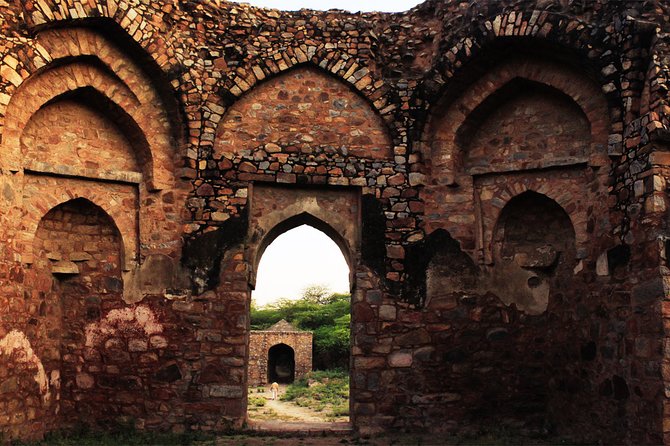
Balban’s Tomb adds another layer. Even in a ruined state, it helps show the scale and age of Delhi’s former royal centers. The guide’s role is important because ruins rarely explain themselves. A good account of who Balban was, why the site mattered, and how the structure changed over time can turn a pile of masonry into a meaningful stop.
The schedule again allows about 20 minutes. That keeps the entire tour within two to three hours, but it also means this is a survey rather than an archaeological study. You will gain orientation and stories, not an exhaustive examination of every wall.
More walking tours in New Delhi:
- The Great Indian Food Tour: Old Delhi Food and Heritage Walk
★ 5.0 · 1,698 reviews - New Delhi Slum Walking Tour
★ 5.0 · 360 reviews - Old Delhi Heritage Walking Tour
★ 5.0 · 247 reviews - 3-hour Old Delhi Heritage Walking tour with Rickshaw Ride
★ 5.0 · 240 reviews
Rajon Ki Baoli and the park’s darker stories
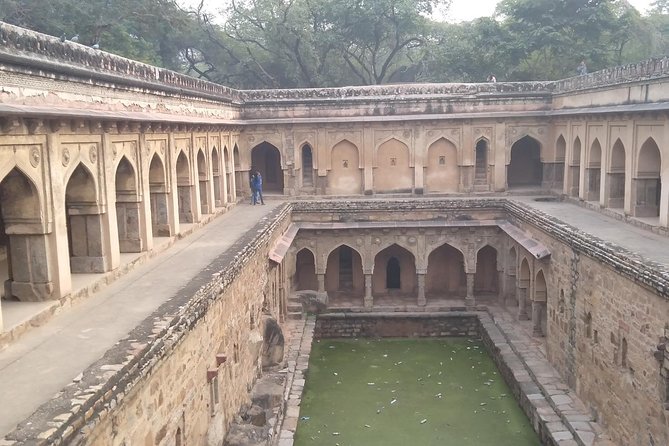
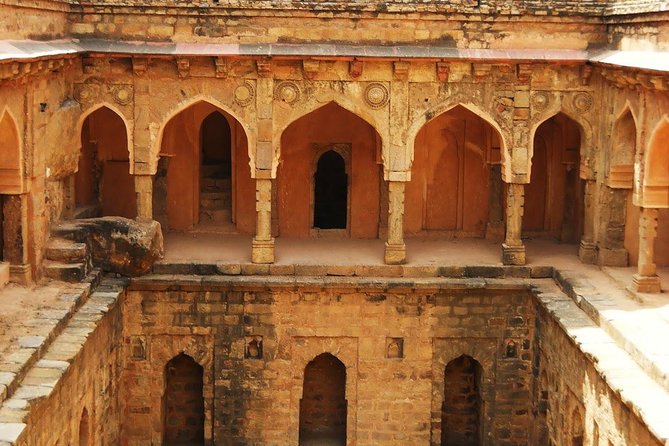
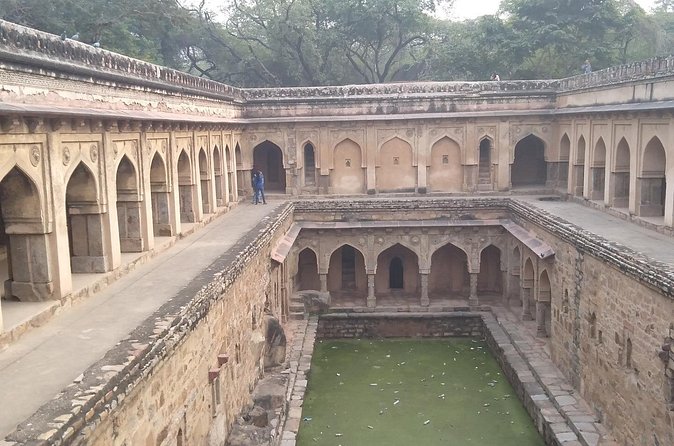
Rajon Ki Baoli is the third main stop, also planned for about 20 minutes. A baoli is a stepwell, built with descending levels and chambers that allowed people to reach water as its level changed.
This baoli takes its name from the masons who lived in chambers around it. The design includes a vertical shaft for drawing water and hollow passageways. Those details show how a water structure could serve more than one purpose. It was not simply a hole in the ground. It formed a built space for access, movement, and shelter around a vital resource.
Rajon Ki Baoli is also described as one of Delhi’s most haunted places. That reputation adds drama, especially if your walk takes place in the quieter morning hours, but the site does not need ghost stories to hold your attention. The engineering and social history are already strong.
The safest way to enjoy the supernatural angle is to see it as part of local storytelling. You can listen to the tales, notice how the dark chambers and enclosed passages shape the mood, and then return to the practical question of how the baoli worked.
This is likely the stop where you will want extra time. The chambers and levels reward a slow look, and the atmosphere changes as you move through the structure. Since the schedule allows around 20 minutes, keep your camera ready but listen closely while the guide explains what you are seeing.
Birds, trees, and a quieter side of Delhi
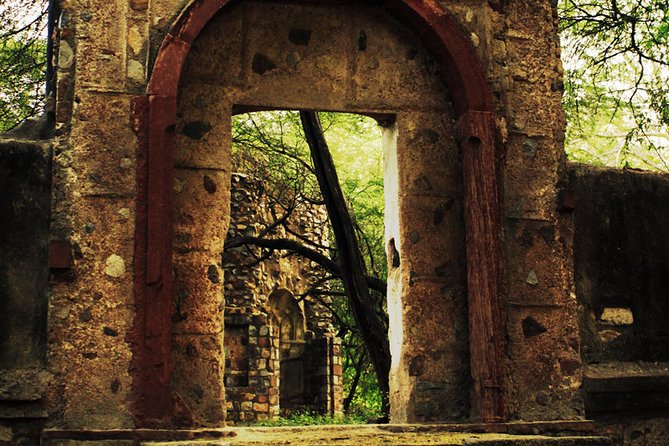
The park is not only a collection of stone monuments. The route passes through greenery and woodland where you might spot different bird species. That natural setting changes the pace of the tour.
I like this part because it gives your eyes a break from masonry and your mind a break from dates and names. Delhi can be intense, but this walk offers pockets of quiet between the ruins. You may find that the birds and trees make the old buildings easier to appreciate by giving them space.
The natural setting also explains why these places have attracted ghost stories. A ruined building surrounded by trees feels more mysterious than the same structure boxed in by traffic. You do not need to accept the supernatural claims to enjoy the mood.
Keep in mind that bird sightings are not guaranteed. The description says you may spot species hidden among the greenery, not that the tour is a formal bird-watching excursion. If birds are your main interest, book this for the ruins and history first, with birdlife as a welcome extra.
What the guide adds to the experience
The guide is the main reason to choose this walk instead of visiting the park without assistance. The monuments are free at the listed stops, so the $28.47 price is primarily paying for interpretation, organization, and local perspective.
Jai Singh is specifically associated with this experience. He has been praised for thorough historical detail, personal conversation, and a willingness to discuss different historical narratives. That last point matters. Delhi’s past is not always a single clean story, and an open conversation can be more useful than a memorized speech.
You should expect the guide to explain the background of the ruins and connect them with the people who shaped the area. The experience can also include discussion of the guide’s life in India, which adds a human element without replacing the main subject.
No guide can turn a short walk into a full course in Delhi history. The quality of the experience will depend on the guide assigned and on how much time the group spends asking questions. Still, the available information suggests that the guide-led format is the heart of the tour, not an optional extra.
Is $28.47 a fair price?
At $28.47 per person, this is a reasonable price for a focused two to three hour walk if you want context rather than just access to the ruins. The listed stops have free admission, and the fee does not cover meals or transport, so the value depends almost entirely on the guide.
For a solo visitor or couple, the price can make sense because arranging a private historian or local expert independently may be harder. Group discounts may also improve the cost for families or friends booking together.
The calculation is less favorable if you only want to wander, take photographs, or visit the park for a few minutes. You are paying for the explanations and the route. If you do not enjoy guided discussion, the same money may feel better spent elsewhere.
The maximum group size is 15. That is not a private tour, but it is small enough to be more flexible than a large sightseeing group. If you value questions, stories, and explanations of details you would otherwise miss, the price is easier to justify.
Timing, comfort, and practical limits
The tour begins in the morning, around 8:00 to 9:00 a.m., and ends back at the meeting point. The total duration is approximately two to three hours. Since the route is a walking experience, wear comfortable shoes and plan for time on uneven historic ground, though the supplied information does not give a formal accessibility rating.
You need to arrange your own transport to Qutub Minar and Ladha Sarai Village. Public transportation is nearby, which helps, but neither transport nor meals is part of the experience.
Most people can participate, according to the activity information. That broad statement should not be read as a promise that every path or ruin will suit every mobility level. If you have specific access needs, confirm the route details before booking.
The activity offers mobile tickets and confirmation at booking. You can cancel for a full refund if you do so at least 24 hours before the start time. Changes or cancellations inside that window are not refunded, and the cut-off follows local time.
Who will enjoy this Mehrauli walk?
I would choose this tour if you have already seen Delhi’s headline sights and want a quieter, more unusual look at the city. It also suits anyone who likes old buildings, local stories, historical debate, and the odd touch of ghost lore.
It is a good fit for couples, small groups, curious solo visitors, and anyone who prefers a short specialist walk to a full-day city tour. The two to three hour length makes it easy to combine with other plans.
Families may enjoy the variety, especially the stepwell and ghost stories, though younger children may lose interest during detailed historical explanations. Architecture students, photographers, and people interested in water systems may find Rajon Ki Baoli especially rewarding.
I would think twice if you dislike walking, want transportation included, or expect grand interiors and polished monuments. Much of the appeal lies in ruins, fragments, open-air explanations, and atmosphere.
Should you book the Mehrauli Archaeological Park tour?
Book it if you want to see a less obvious side of Delhi and value a guide who can connect tombs, mosques, stepwells, colonial follies, and local legends. The combination of Jamali Kamali, Balban’s Tomb, Metcalf Canopy, and Rajon Ki Baoli gives you a strong sample of Mehrauli in a short morning.
The best reason to book is the interpretation, especially if Jai Singh is leading your walk. The clearest caution is that $28.47 covers a guide-led walking experience, not transport, food, or an all-day tour.
For a compact, thoughtful introduction to Delhi’s archaeological ruins, I would consider it good value. Just arrive ready to walk, listen, and accept that some of the most interesting parts are broken, quiet, and a little mysterious.
FAQ
Where does the tour begin?
The tour begins near Qutub Minar at Aam Bagh, Ladha Sarai Village, Mehrauli, New Delhi, Delhi 110030, India.
Where does the tour end?
The activity ends back at the meeting point.
How long does the walking tour last?
The tour lasts approximately two to three hours.
What time does the tour begin?
The start time is around 8:00 to 9:00 a.m.
Which main places are included?
The main stops are Jamali Kamali Tomb and Mosque, Balban’s Tomb, Metcalf Canopy, and Rajon Ki Baoli.
Is a guide included?
Yes. A local expert guide is included.
Are meals and transport included?
No. Meals and transport are not included.
What is the cancellation policy?
You can cancel at least 24 hours before the start time for a full refund. Cancellations or changes made less than 24 hours before the start time are not refunded.
More 3-Hour Experiences in New Delhi
- Spice & Stories: 3-Hour Old Delhi Heritage Food Walk Guided Tour
★ 4.5 · 36 reviews - Best Of Old Delhi: 3 Hour Tuk Tuk/Rickshaw Tour
★ 5.0 · 10 reviews - Spice Market & Old Delhi Highlights: Guided 3-Hour Tour
★ 4.5 · 6 reviews - Delhi: Pub Crawl (3 Hours Guided Bar Hopping Tour)
★ 3.5 · 6 reviews
Newly reviewed around New Delhi
- Private Customized Tour Of Old/New Delhi Spiritual Sites★ 5.0 · 5 reviews
- Yoga and Meditation Classes in Gurgaon★ 4.5 · 8 reviews
- Yoga class in Delhi★ 5.0 · 29 reviews
- 5 Days Golden Triangle Tour with Ranthambore(Delhi Agra Jaipur Ranthambore Tour)★ 5.0 · 3 reviews
- Wonderful Old & New Delhi sightseeing tour★ 5.0 · 3 reviews
- Old Town Delhi Walking Tour (2 Hours Guided Tour with Local)★ 4.5 · 22 reviews
- Hidden Gems of Old Delhi – Walk★ 5.0 · 8 reviews
- Delhi Zoo White Tigers & lions with Old Fort Visit★ 4.5 · 5 reviews
Delhi Walking Tours, compared.

The Great Indian Food Tour: Old Delhi Food and Heritage Walk
Read our review →


3-hour Old Delhi Heritage Walking tour with Rickshaw Ride
Read our review →
Old Delhi Walking Tour: Food, Culture & Spice Bazaars
Read our review →
Timeless Treasures: An Old Delhi Heritage Walking Tour
Read our review →

3-4 Hour Old Delhi Heritage Walk Tour with Tuk Tuk Ride Wherever Required
Read our review →Browse the lists this tour appears in